
Introduction
Installing lightning protection, surge protection, and earthing systems is only part of establishing electrical safety in an industrial facility. Before a new manufacturing plant, warehouse, or production building becomes operational, these systems must be inspected and tested to verify that their installation meets the approved engineering design.
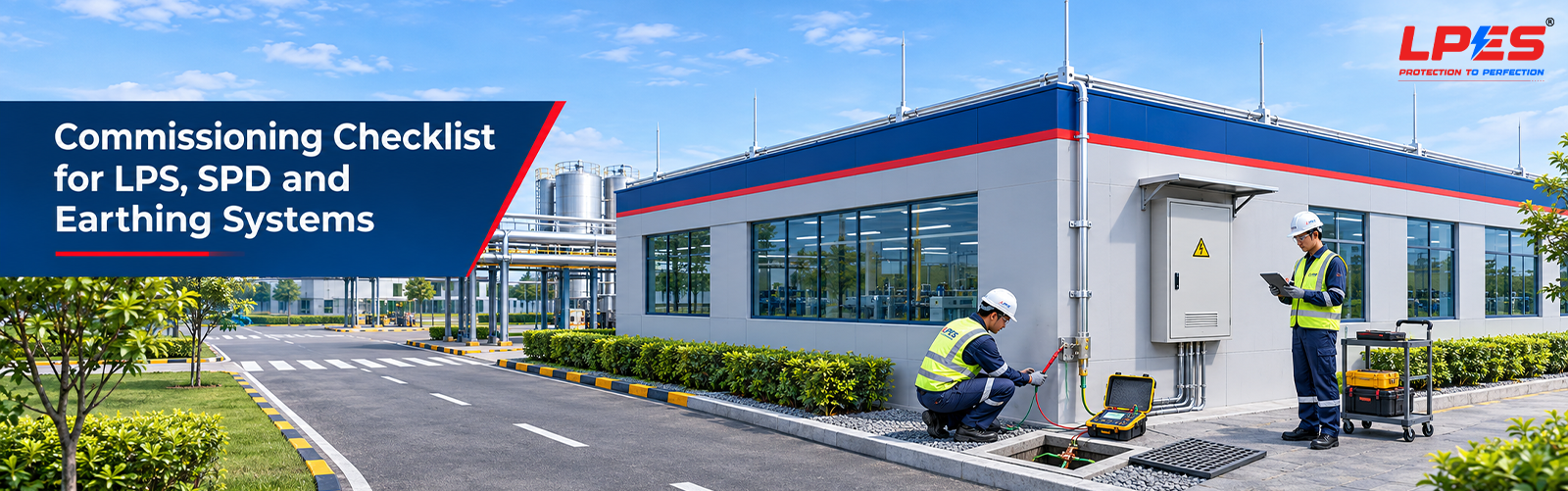
A commissioning checklist for LPS, SPD and earthing systems helps project engineers, electrical contractors, and facility teams identify installation defects, verify electrical connections, and document system performance before final handover.
Commissioning should cover the complete protection arrangement, from rooftop air terminals and down conductors to surge protection devices, earthing electrodes, and equipotential bonding. Each system performs a different function, but their coordination is essential for managing lightning-related electrical risks.
Why Commissioning Matters in Industrial Facilities
Manufacturing facilities contain interconnected electrical infrastructure, including transformers, main distribution boards, motor control centres, PLC panels, variable frequency drives, and industrial communication networks. These systems can be affected by lightning currents, transient overvoltages, and electrical faults.
An incorrectly installed down conductor, disconnected bonding connection, or improperly selected SPD may compromise the intended protection arrangement. Such defects are not always apparent during routine visual checks.
A structured commissioning process helps identify these problems before the facility enters normal operation. It also establishes baseline measurements and records that can support future inspection, maintenance, and troubleshooting.
1. Pre Commissioning: Review Drawings and Documentation
Commissioning should begin with an engineering document review rather than immediately proceeding to electrical testing. This establishes what has been designed, what has been installed, and which acceptance criteria apply.
The commissioning team should verify the following documentation:
Approved design drawings: Confirm the locations and routes of air terminals, down conductors, SPDs, earth electrodes, and bonding connections.
Lightning risk assessment: Review the selected lightning protection level and the protective measures identified during design.
Material specifications: Check installed conductor sizes, component ratings, electrode materials, and SPD specifications against approved submissions.
Installation records: Review inspection reports, concealed-work photographs, joint records, and construction-stage approvals.
Testing procedures: Confirm that approved test methods, calibrated instruments, and project-specific acceptance criteria are available.
Any differences between approved drawings and site conditions should be recorded and technically reviewed before final acceptance.
2. Lightning Protection System Commissioning Checklist
The external lightning protection system consists of air termination arrangements, down conductors, connecting components, and earth termination connections. Commissioning must establish whether these components have been installed correctly and form the intended conductive paths.
Air Terminals and Roof Conductors
Air terminals should be inspected for correct positioning, secure mounting, suitable material selection, and connection to the rooftop conductor network. Their locations should match the approved protection zone design, including arrangements for rooftop machinery, HVAC units, and other exposed equipment.
Down Conductors and Test Connections
Down conductors must follow the intended routing and remain properly secured to the structure. Accessible joints and test links should be examined for mechanical integrity and electrical continuity.
Key LPS commissioning checks:
Verify air terminal positions against approved lightning protection drawings.
Inspect conductor routing, sizes, supports, bends, and mechanical connections.
Check down conductor continuity using suitable test instruments.
Verify test joints, bonding arrangements, and required separation distances.
Inspect connections between down conductors and the earth termination system.
Continuity measurements should be evaluated against the approved design and applicable testing requirements. Testing should establish the integrity of the intended electrical path rather than relying solely on visual inspection.
3. Surge Protection Device Commissioning Checklist
Surge protection devices help limit transient overvoltages reaching electrical and electronic equipment. In industrial facilities, SPDs may be installed at main distribution boards, sub-distribution boards, control panels, and selected communication interfaces.
Commissioning should verify both the suitability of the SPD and its installation. A correctly rated device may not provide its intended protection if it is connected incorrectly or installed with unsuitable conductor routing.
Important SPD Checks
SPD selection: Verify the specified Type 1, Type 2, or Type 3 classification according to the installation location and protection design.
Electrical ratings: Review maximum continuous operating voltage (Uc), voltage protection level (Up), and applicable discharge current ratings.
Connection arrangement: Confirm wiring configuration, polarity where applicable, and compatibility with the facility's earthing arrangement.
Connection lengths: Check that conductors are routed as directly and as short as practicable according to the design and manufacturer's requirements.
Protective devices and indicators: Verify associated overcurrent protection, disconnection arrangements, status indicators, and remote alarm connections where provided.
For manufacturing facilities, SPD coordination between incoming panels and sensitive control equipment is particularly important. The commissioning team should confirm that the installed surge protection arrangement follows the engineering design.
Routine site commissioning generally does not involve applying destructive lightning impulse tests to installed SPDs. Such performance testing belongs to appropriate product testing procedures.
4. Earthing and Grounding System Commissioning Checklist
Earthing and grounding systems provide electrical reference, fault-current paths, and connections required for lightning protection and electrical safety.
Before commissioning, the installed earthing network should be compared with the approved drawings. Earth electrodes, earth pits, buried conductors, test points, and main earthing terminals must be checked for correct installation and accessibility.
Essential Inspection and Testing Points
Earth electrode installation: Verify electrode type, dimensions, location, and installation details against the approved design.
Earthing conductor continuity: Check relevant electrical connections between electrodes, earth bars, equipment enclosures, and the main earthing terminal.
Earth resistance measurement: Perform suitable measurements using approved test procedures and instruments.
Joint inspection: Examine accessible mechanical connections, exothermic welded joints, and conductor terminations for defects.
Equipotential bonding: Verify required bonding of structural steel, metallic services, electrical enclosures, and other conductive components.
Earth resistance results should be evaluated against the facility's design criteria and applicable standards. There is no single resistance value suitable for every industrial earthing arrangement.
Soil conditions, electrode configuration, fault protection requirements, and the purpose of the earthing network must all be considered during evaluation.
5. Integrated System Verification Before Energisation
LPS, SPD, and earthing systems should not be assessed entirely in isolation. Commissioning must also verify the connections and coordination between them.
For example, a rooftop lightning protection system may have satisfactory conductor continuity, while a missing bonding connection or incorrectly connected SPD creates a weakness elsewhere in the protection arrangement.
The commissioning team should verify that the external lightning protection system, main earthing terminal, electrical protective conductors, and surge protection connections follow the approved coordinated design.
Electrical testing should be performed under controlled safety conditions by qualified personnel. Appropriate isolation, permit procedures, and equipment-specific precautions are required. Sensitive equipment and SPDs may need to be disconnected before insulation resistance testing, where specified.
Controlled energisation and functional checks should follow only after the relevant pre energisation inspections and electrical safety requirements have been satisfied.
6. Commissioning Reports and Final Handover
A properly documented commissioning process provides evidence of inspections, measurements, identified defects, and corrective actions. It also establishes reference information for future maintenance.
The final commissioning package should include:
Documentation | Purpose |
Approved and as built drawings | Record the installed system arrangement |
LPS inspection and continuity reports | Document physical condition and electrical continuity |
SPD installation and status records | Verify device selection, connections, and indications |
Earthing and bonding test reports | Record relevant measured results |
Non-conformance and corrective action records | Track defects and their closure |
Final acceptance documentation | Record review and handover status |
Outstanding defects should be assessed and resolved according to their safety significance and project acceptance requirements. Final handover should occur only after the necessary verification and approvals have been completed.
Standards and Engineering Considerations
Lightning protection commissioning should follow applicable standards, project specifications, and approved engineering procedures.
IEC 62305-3:2024 addresses the design, installation, inspection, and maintenance of external lightning protection systems. IEC 62305-4:2024 covers surge protection measures for electrical and electronic systems within structures.
IEC 61643-11:2025 specifies requirements and test methods for relevant low voltage AC surge protective devices. IEC 60364-5-53 provides requirements relevant to electrical equipment selection and installation. In India, IS 3043:2018 is an important reference for earthing practices, subject to applicable updates and project requirements.
Inspection records, verified material specifications, installation drawings, and test results help demonstrate whether the installed systems meet their defined acceptance criteria.
About LPES International
LPES International provides engineering-focused solutions for lightning protection, surge protection, earthing, grounding, and electrical safety across industrial, commercial, and infrastructure facilities. Its capabilities include lightning risk assessment, protection system design, AutoCAD based engineering drawings, technical consultation, material selection, and coordinated protection planning. By considering external lightning protection, electrical distribution, surge protection, and earthing as connected systems, LPES supports engineering decisions throughout the project lifecycle.
Why Choose LPES International?
1. Engineering Expertise: Technical knowledge of lightning protection, surge protection, and grounding supports appropriate system planning and verification requirements.
2. Customized Protection Design: Protection arrangements are developed around facility geometry, electrical infrastructure, and equipment sensitivity.
3. Risk Based Planning: Lightning risk assessment helps establish appropriate protection measures based on site specific exposure and requirements.
4. Quality Focused Material Selection: Components are selected with consideration for technical specifications, environmental conditions, and installation requirements.
5. Technical Consultation and Project Support: Engineering inputs support design coordination, installation planning, inspection requirements, and system verification.
Conclusion
A commissioning checklist for LPS, SPD and earthing systems provides a structured approach to verifying electrical protection installations before operational handover. Effective commissioning includes design verification, physical inspection, continuity testing, earthing measurements, SPD installation checks, equipotential bonding verification, and complete documentation. These activities help identify installation defects, support electrical safety, and improve confidence in the facility's protection arrangements.
Contact LPES International for lightning risk assessment, engineered lightning protection design, surge protection solutions, earthing and grounding systems, and technical consultation for industrial electrical protection projects.