Lightning, earthing and surge protection for FMCG, food and beverage plants
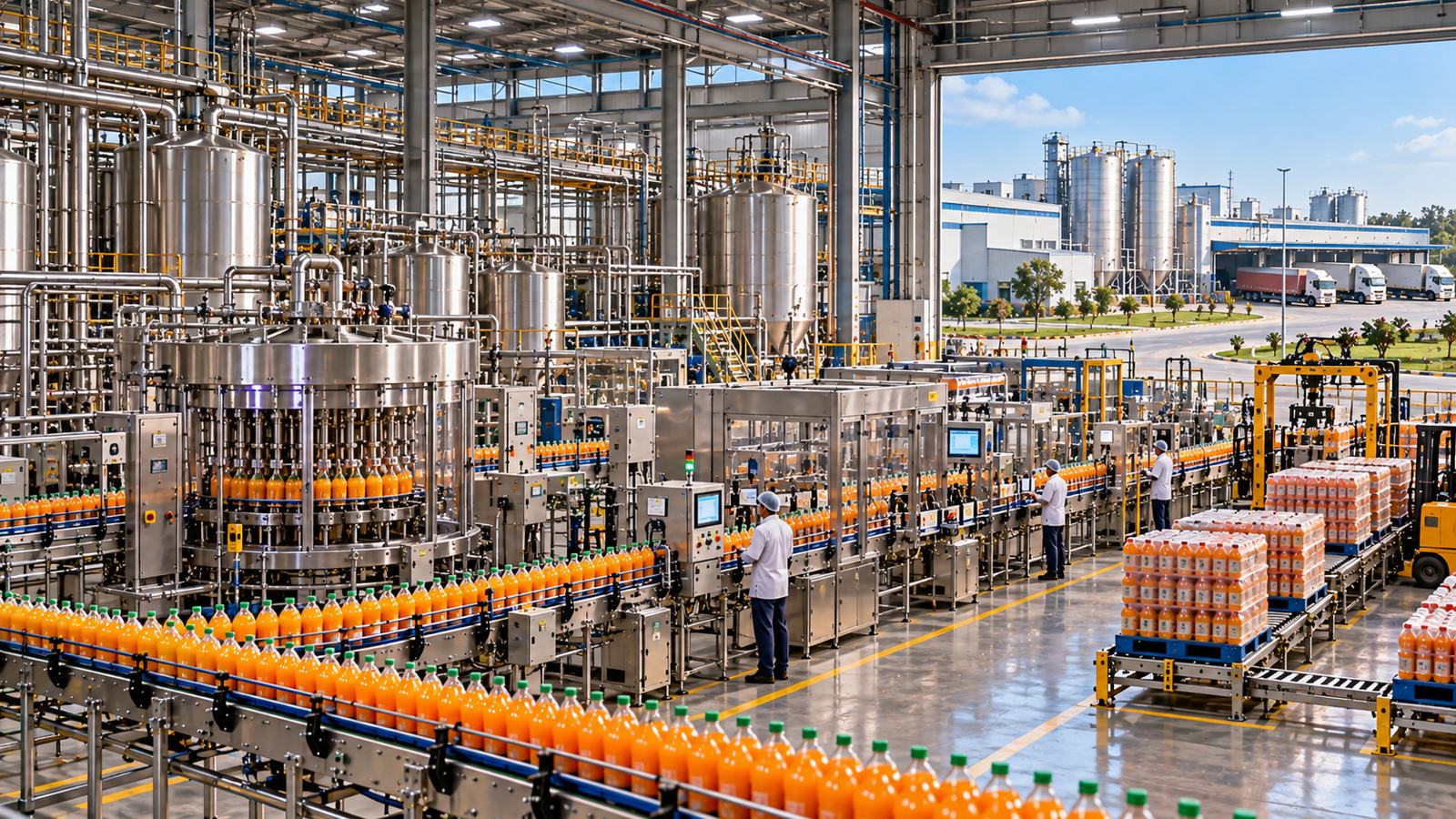
A filling line runs by the second and stops as one machine. When a surge takes out a filler controller or an inspection system, product is lost, the line has to be cleaned and restarted, and the shift target is gone. LPES protects the buildings, the wet-area earthing and bonding, and the line automation as one coordinated system.
FMCG & Beverages
Process hall roof and rooftop plant
- Threat
- Direct strikes to the roof and to air handling units, exhaust fans and PV arrays.
- LPES measure
- The metal roof is used as natural air termination where thickness and continuity allow. Rooftop units are placed inside the protected volume with air rods on non-penetrating holders.
- Families
Lightning, earthing and surge risks on food and beverage plant sites
A line that stops as one machine
Filler, capper, labeller, inspection and packer are synchronised. A surge that resets one controller stops them all, and product in the filler is wasted.
Wet floors and stainless steel
Equipment is washed down every shift. Tanks, pipework, platforms and conveyors are all conductive and within reach, so a small potential difference is a shock risk.
Sugar, flour, starch and milk powder
Fine food powders form combustible dust. Static built up in pneumatic conveying, silos and mixers is an ignition source inside a classified zone.
Utilities that product depends on
Refrigeration, boilers, compressed air and water treatment run on drives and controllers. When they trip, chilled and in-process product is at risk within minutes.
One coordinated lightning protection, earthing and surge protection system
Four pillars. Connected protection. Clear accountability.
Lightning protection, earthing and surge protection only work when they are designed together. LPES is the four parts of that system in one name.

Lightning protection
Process halls, warehouses, utility blocks, silos and stacks are assessed together. Roofs and silo shells are used as natural components where their thickness and continuity are proven, and rooftop plant gets air termination that does not penetrate the roof.

Power protection
Protection only works if the power system lets it. LPES studies the fault levels, neutral earthing, earth-fault loop impedance and protection settings, so that every PE conductor is sized for its fault current and every protective device disconnects in time.

Earthing protection
One earthing system serves power, automation and lightning. Wet process areas get supplementary equipotential bonding in stainless steel, powder handling gets verified static earthing, and every area grid is interconnected.

Surge protection
Protection follows the power path. Type 1+2 at the incomer, Type 2 at MCCs and machine supplies, Type 3 and data-line SPDs at PLCs, inspection systems and network switches. Status indication shows a spent module during routine rounds.
Products are available in four series, LPES BASIC, LPES SMART, LPES PRO and LPES CENTURY, so the specification can match the duty and the budget of each area of the site.
Earthing and PE conductors: what protects people, and what CEA 2023 requires
An electrode in the ground protects nobody on its own. People and equipment are protected by the conductors that join every frame, panel and pipe back to the main earthing terminal. The CEA Safety Regulations 2023 make these connections mandatory. Select a conductor to see the rule, the sizing and the LPES material. The LPES shields mark where lightning, power, earthing and surge protection apply on the plant, down to the SPD type at each level.
Protective earthing (PE) conductor
Main earthing terminal to the frame of every piece of equipment
On a food and beverage plant. Fillers, conveyors and pumps run in wet areas. A loose PE leaves a frame live where operators stand on wet floors.
- Rule
- CEA Reg 43(vii): two separate and distinct connections for apparatus above 250 V. Reg 43(ix): carries the prospective earth-fault current.
- Limit
- Earth-fault loop impedance: measured Zs ≤ ⅔ × U0 / Ia, so the device disconnects in 0.4 s at 230 V and 0.2 s above 230 V on TN final circuits.
- Sizing
- IS 3043:2026, Table 12, same material as the line conductor S: equal to S up to 16 mm², 16 mm² for S from 16 to 35 mm², S/2 above 35 mm². Or by the adiabatic equation S = √(I²t) / k.
- Material
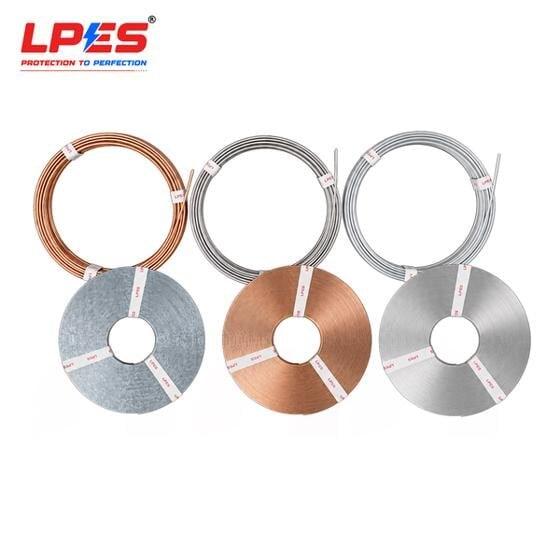
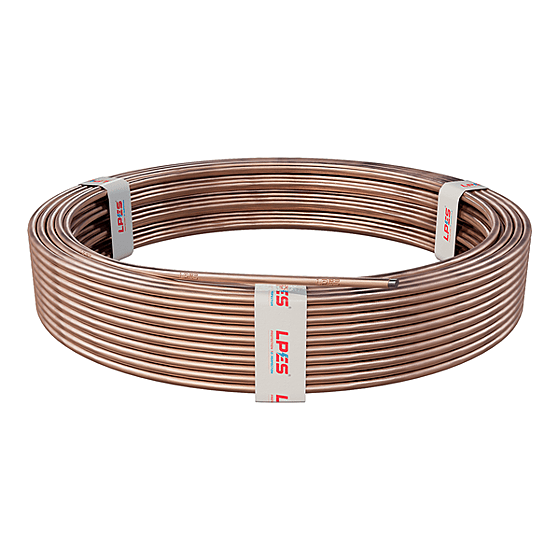
- Insulated green-yellow copper cable, copper tape or copper-bonded conductor, with crimped lugs at both ends. No soldered joints and no switch in the PE.
- Families
On your food and beverage plant site
Motors, MCCs and machines above 250 V get two separate earth connections. In wet areas insulated copper PE and stainless steel bonding hardware are used so nothing corrodes or sheds. Flexible links bridge conveyors and vibrating equipment.
- Reg 43(vii)Frames of motors and consuming apparatus above 250 V are earthed by two separate and distinct connections.
- Reg 43(v)Every building has protective equipotential bonding.
- Reg 38(3)(vi)Lightning protection as per relevant standards for industrial installations and test laboratories.
- Reg 43(xi)Earth-fault loop impedance is tested and the record is kept.
Two points from IS 3043:2026 that change how earthing is specified. At low voltage there is no minimum earth electrode resistance: protection depends on the earth-fault loop impedance and on the protective device tripping in time. And separate “dedicated” or “clean” earth pits for neutral, body, instruments or electronics are not to be used: every electrode joins one interconnected earthing network.
Clause references are to the Central Electricity Authority (Measures relating to Safety and Electric Supply) Regulations, 2023. Sizing lines follow IS 3043:2026 and IS 732:2019. Confirm against the current official text and state notifications before using them in a tender or inspection.
LPS class, SPD rating and conductor sizes for food and beverage plant projects
The figures engineers look up most, with the clause behind each. Rows marked in red are specific to food and beverage plant sites.
| Item | Value | Source |
|---|---|---|
| Steel frame or rebar as down conductor | Overall continuity 0.2 Ω or less, measured four-wire at about 10 A | IEC 62305-3:2024, D.5.3.5 |
| Drives with high PE current (over 10 mA) | PE of at least 10 mm² copper, or a second PE | IS 3043:2026, 7.6 |
| Panel PE terminal to any exposed part | 0.1 Ω or less, tested at 10 A or more | IS 3043:2026, 7.1 |
| Separate “instrument” earth pits | Not permitted. One interconnected earthing network | IS 3043:2026, 6.3 |
| Rolling sphere radius | 20 / 30 / 45 / 60 m for LPS Class I / II / III / IV | IEC 62305-3:2024, Table 2 |
| Air-termination mesh | 5 / 10 / 15 / 20 m for Class I / II / III / IV | IEC 62305-3:2024, Table 2 |
| Down-conductor spacing | 10 / 10 / 15 / 20 m for Class I / II / III / IV | IEC 62305-3:2024, Table 5 |
| LPS conductor, minimum | 50 mm² in copper, aluminium, galvanised or stainless steel | IEC 62305-3:2024, Table 7 |
| Lightning earth | Ring electrode at least 0.5 m deep, about 1 m from the walls. Aim below 10 Ω | IEC 62305-3:2024, 5.4 |
| Entrance SPD where an LPS exists | Type 1 (Class I). Iimp 25 / 18.75 / 12.5 kA per pole for LPL I / II / III–IV | IEC 62305-4:2024, Table C.3 |
| SPD connecting leads | 0.5 m total or less, line to SPD to earth bar | IEC 62305-4:2024, Annex C |
| Second SPD | Needed when equipment is more than 10 m from the entrance SPD | IEC 62305-4:2024, Annex C |
| Bonding bar to earth | 16 mm² copper, 25 mm² aluminium or 50 mm² steel | IEC 62305-3:2024, Table 9 |
| Disconnection time, TN final circuits | 0.4 s at 230 V, 0.2 s above 230 V | IS 3043:2026, Table 1 |
| Loop impedance, measured | Zs ≤ ⅔ × U0 / Ia | IS 3043:2026 and IS 732 |
| PE and bonding continuity | Within the conductor’s own resistance, tested at about 10 A | IS 3043:2026, Annex E |
The LPS class and the SPD protection level are set by an IEC 62305-2 risk assessment for the site, not chosen from this table. Values are quoted for reference and must be confirmed against the current edition of each standard at design stage.
Every part of the food and beverage plant protection system has its own test standard
IEC 62305 sets the design. The IEC 62561 series sets the test for each component that carries lightning current. A system holds only if the clamp, the conductor and the electrode each pass their own test.
| Component | What the standard proves | Standard |
|---|---|---|
| Clamps, connectors and bonding parts | Each joint is aged in salt mist and a humid sulphurous atmosphere, then tested with lightning current. Class H is tested at 100 kA and class N at 50 kA. | IEC 62561-1 |
| Conductors and earth electrodes | Sets the material, cross-section and coating of tapes, round conductors and rods. A copper-bonded steel rod carries at least 250 µm of 99.9 % copper. | IEC 62561-2 |
| Isolating spark gaps | Joins metal parts that must stay separate in service, such as insulating flanges and cathodically protected pipes. The gap conducts only during a strike. | IEC 62561-3 |
| Conductor holders and fixings | Holders are tested for mechanical strength after environmental ageing, so the conductor stays in place on roofs, walls and structures. | IEC 62561-4 |
| Earth pit housings and electrode seals | Inspection housings are load tested. Seals are tested where an electrode passes through a waterproofed slab. | IEC 62561-5 |
| Lightning strike counters | The counter records each strike carried by a down conductor. A new count is the trigger for an inspection. | IEC 62561-6 |
| Earth enhancing compounds | The compound is tested for leaching, sulphur content, resistivity and corrosion of the electrode buried in it. | IEC 62561-7 |
| Surge protective devices | Part 11 covers SPDs on AC power, part 21 covers signal and data lines, and part 31 covers the DC side of PV plants. | IEC 61643-11, IEC 61643-21, IEC 61643-31 |
| PE, bonding and earthing conductors | Sets the size, material, joints and continuity of every protective conductor from the earth electrode to the equipment frame. | IEC 60364-5-54, IS 3043:2026, IS 732:2019 |
LPES components are built and comply to the parts listed. Ask for the test report of the specific product with your enquiry. Confirm clause values against the current edition of each standard at design stage.
What goes into your food and beverage plant project
Each card opens the product family in the LPES catalogue.
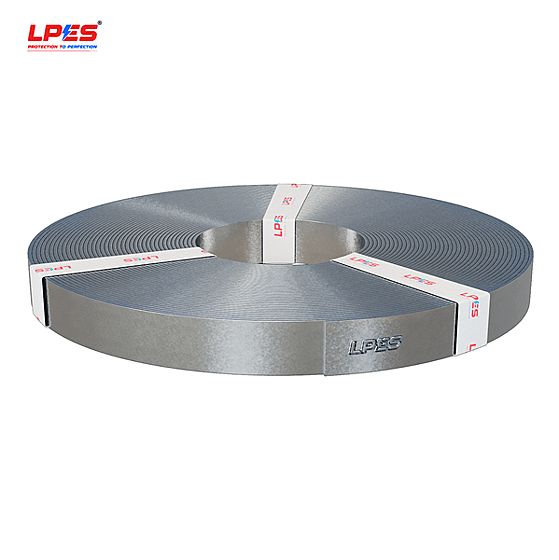
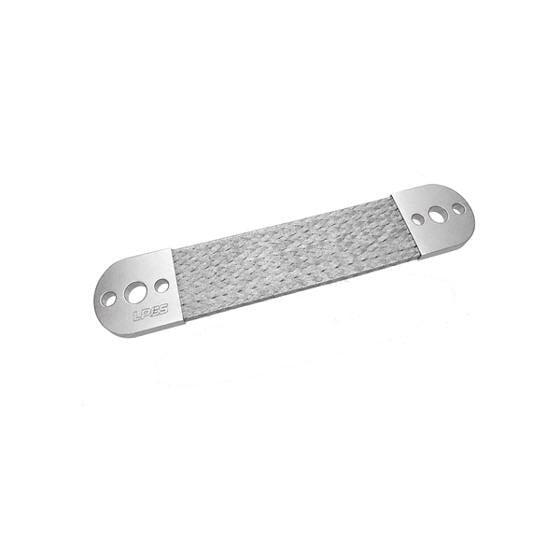
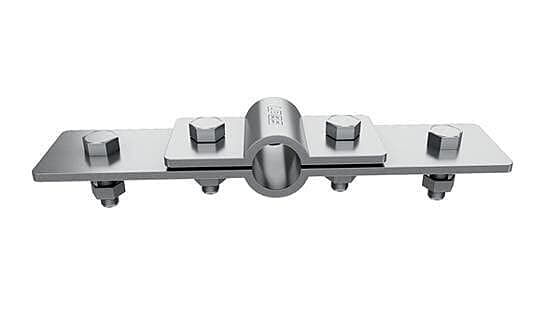
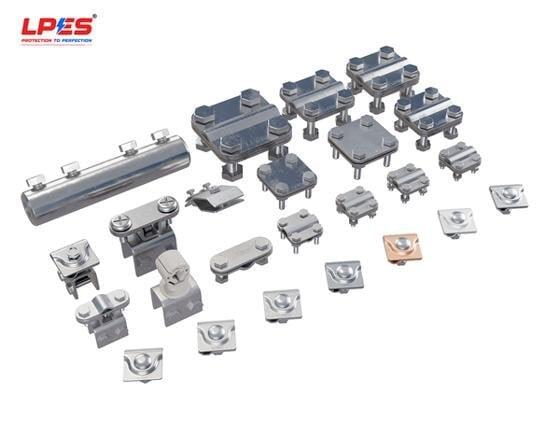
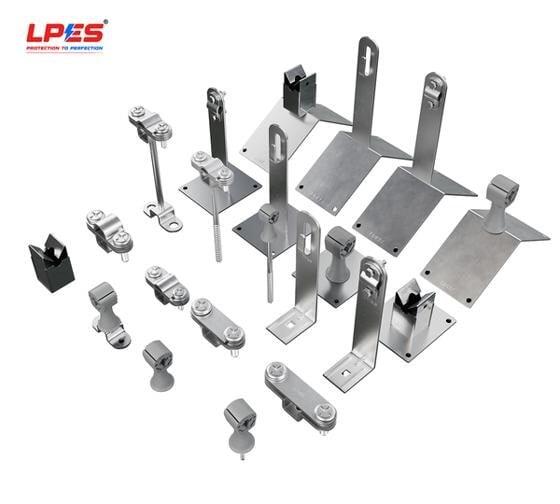
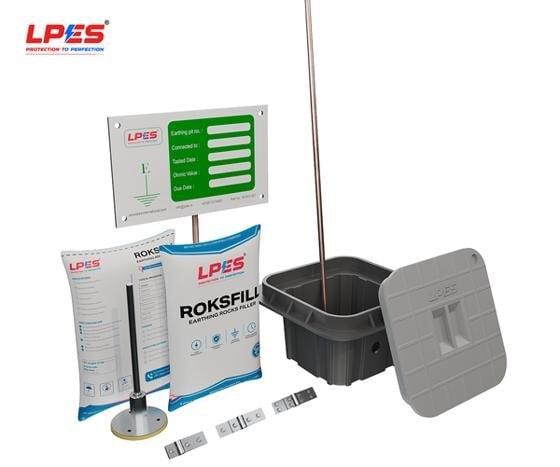
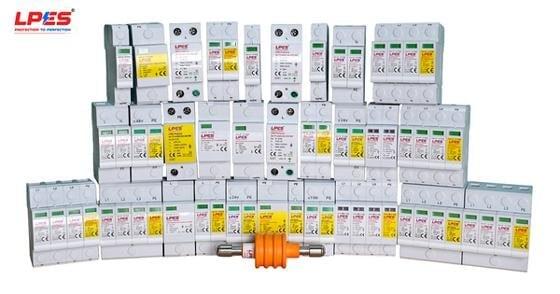
Areas LPES covers in fmcg & beverages
- Beverage, juice and water bottling lines
- Dairy processing and cold stores
- Biscuit, snack and confectionery lines
- Edible oil, flour and sugar handling
- Soap, detergent and personal care plants
- Silos, tank farms and CIP stations
- Refrigeration, boilers and utilities
- Warehouses and dispatch
Is your food and beverage plant site ready for an inspection?
Six points an Electrical Inspector or an insurer will ask about.
- Every motor and panel above 250 V has two separate earth connections.Reg 43(vii)
- Protective equipotential bonding is installed and was tested before energisation.Reg 43(v), 43(ix)
- Earth-fault loop impedance has been tested for each circuit and each source.Reg 43(xi)
- Earth resistance is tested every year in the dry season and the record is kept.Reg 50(8)
- The lightning protection system has a current risk assessment and inspection record.Reg 38(3)(vi)
- SPDs are fitted at the incomers and their status is checked on rounds.IEC 62305-4
Answer the six points for your site. Nothing is sent anywhere until you ask.
What each person on a food and beverage plant project asks
When did we last prove that every protective conductor is continuous and every breaker will trip on an earth fault?
LPES measures loop impedance and PE continuity circuit by circuit and hands over the record.
Testing & MeasurementLightning to Load
Seven stages, from the first risk assessment to the yearly inspection, with clear ownership at every interface.
Calculated. Coordinated. Implemented. Verified.
- AssessIEC 62305-2 risk assessment, site audit, soil resistivity survey
- DesignLPS, earthing and SPD design with calculations and drawings
- SpecifyBill of materials with LPES part numbers and data sheets
- SupplyProducts from one source, tested to IEC 62561 and IEC 61643
- ImplementInstallation supervision or turnkey execution
- VerifyContinuity, earth resistance and SPD checks, recorded
- AssurePeriodic inspection, monitoring and AMC
LPES Protection Passport. Every project closes with one document set: risk assessment, as-built drawings, product list with part numbers, test records and the inspection plan.
LPES servicesBuilt and comply to
- CEA Safety Regulations 2023
- IEC 62305-1 to -4
- IEC 62561 series
- IEC 61643-11 and -21
- IEC 60364-5-53
- IEC 60204-1
- IEC 60079-14
- IS 3043:2026
- IS 732:2019
The applicable edition and any project or statutory specification are confirmed at the design stage.
FMCG & Beverages lightning protection and earthing: frequently asked questions
Why does a food plant need extra bonding when everything already has an earth wire?
Related: Equipotential Bonding ›
Our machines came with their own protection. Why add SPDs?
Related: Type 2 SPDs ›
Is sugar or flour dust really an ignition risk?
Related: Static Earthing (Ex) ›
What will a food safety or insurance audit ask for?
Related: Testing & Measurement ›
Engineering guides from the LPES knowledge hub
- Earthing of installations with higher protective conductor currentHB-ID-536
- Supplementary bonding and installations with increased shock riskHB-ID-533
- Types of protective earthing conductors and their electrical continuityHB-ID-530
- Earthing conductor and protective bonding conductor sizingHB-ID-528
- Main earthing terminal / main earth busbar (MET)HB-ID-529
- Fault protection by automatic disconnection in TN, TT and IT systemsHB-ID-532
- Measurement of earth fault loop impedance
- Continuity resistance measurement
Related industries
- PharmaceuticalIndustry page
- Plastics & PolymersIndustry page
- Chemicals & FertilisersIndustry page
- Storage EquipmentIndustry page
More in Manufacturing & Process
- Manufacturing & ProcessSector overview
- Automobile IndustryIndustry page
- CementIndustry page
- Chemicals & FertilisersIndustry page
- Electronics & EMSIndustry page
- Paints & CoatingsIndustry page
- Plastics & PolymersIndustry page
- Steel & MetalsIndustry page
- Textiles & GarmentsIndustry page
- All industriesIndustries overview
Your power is connected. Is your protection?
Bring your electrical protection together. Understand your risks. Coordinate your protection. Know who owns each responsibility.
Talk to LPES about a coordinated assessment for your food and beverage plant project, from Lightning to Load. You get: a risk assessment and a protection concept, based on your site layout and single line diagram.