Lightning, earthing and surge protection for data centres
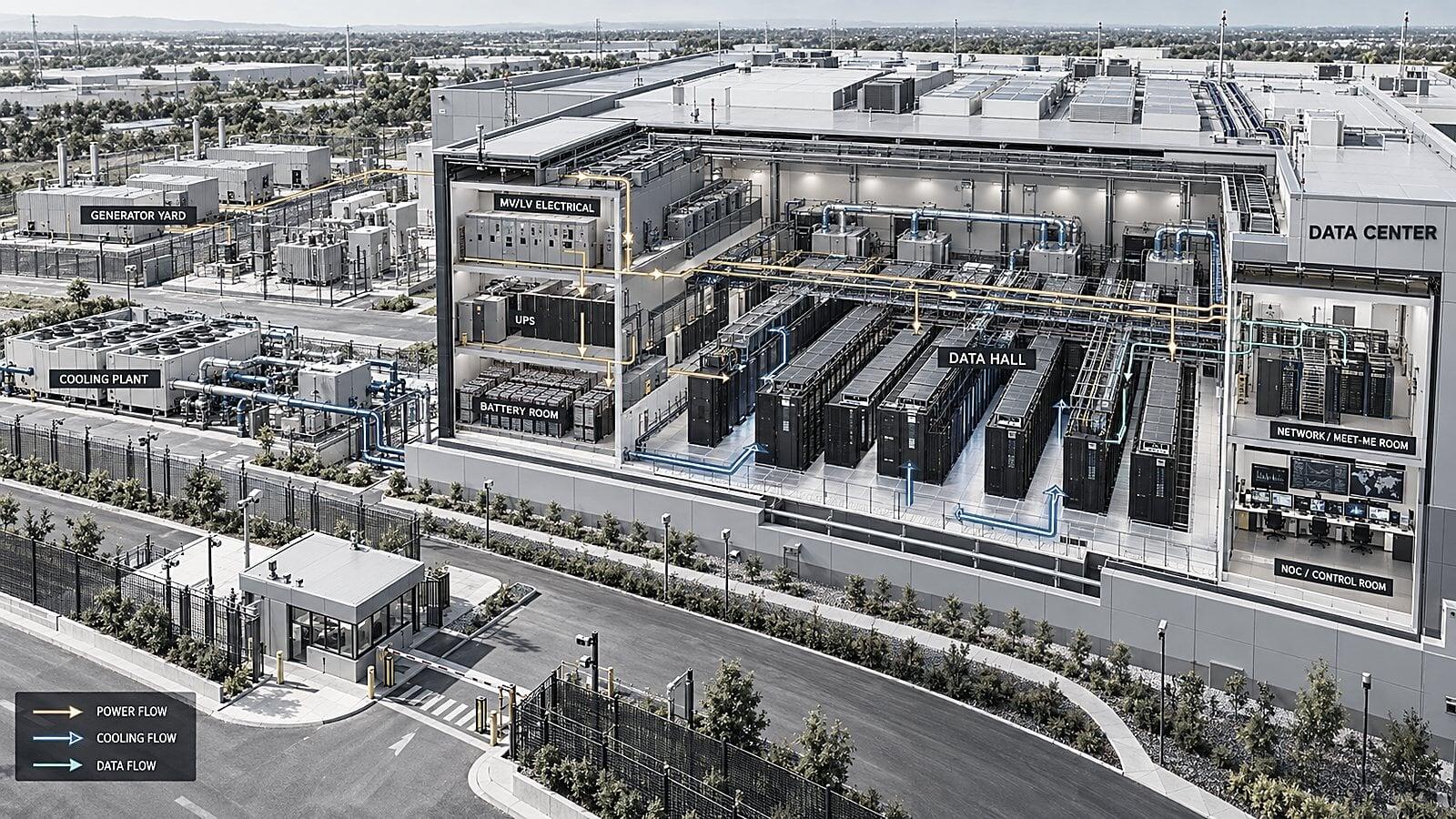
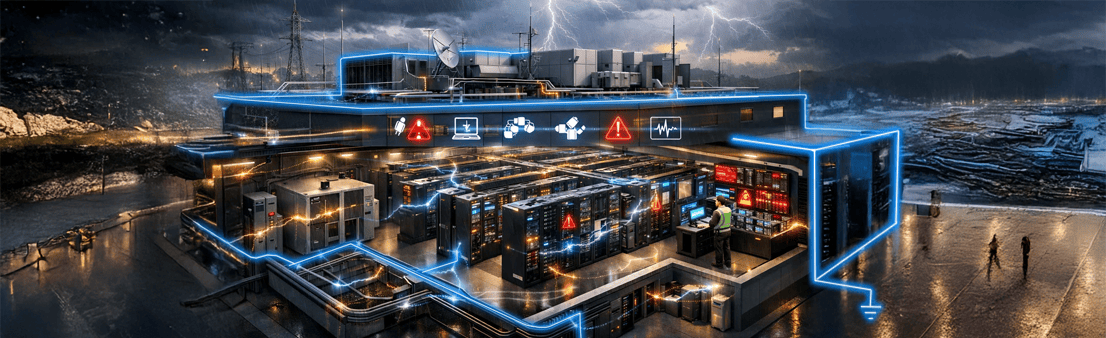
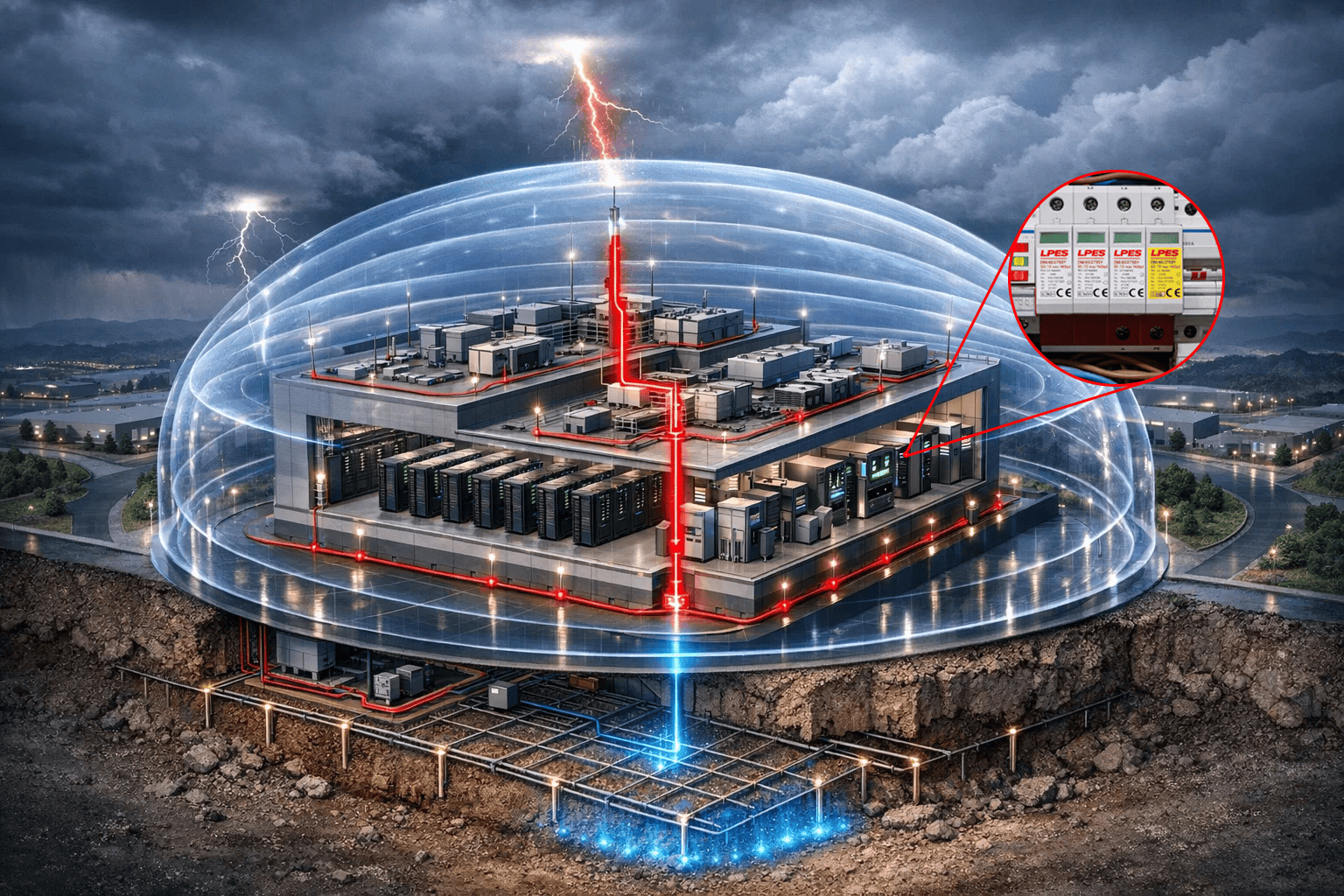
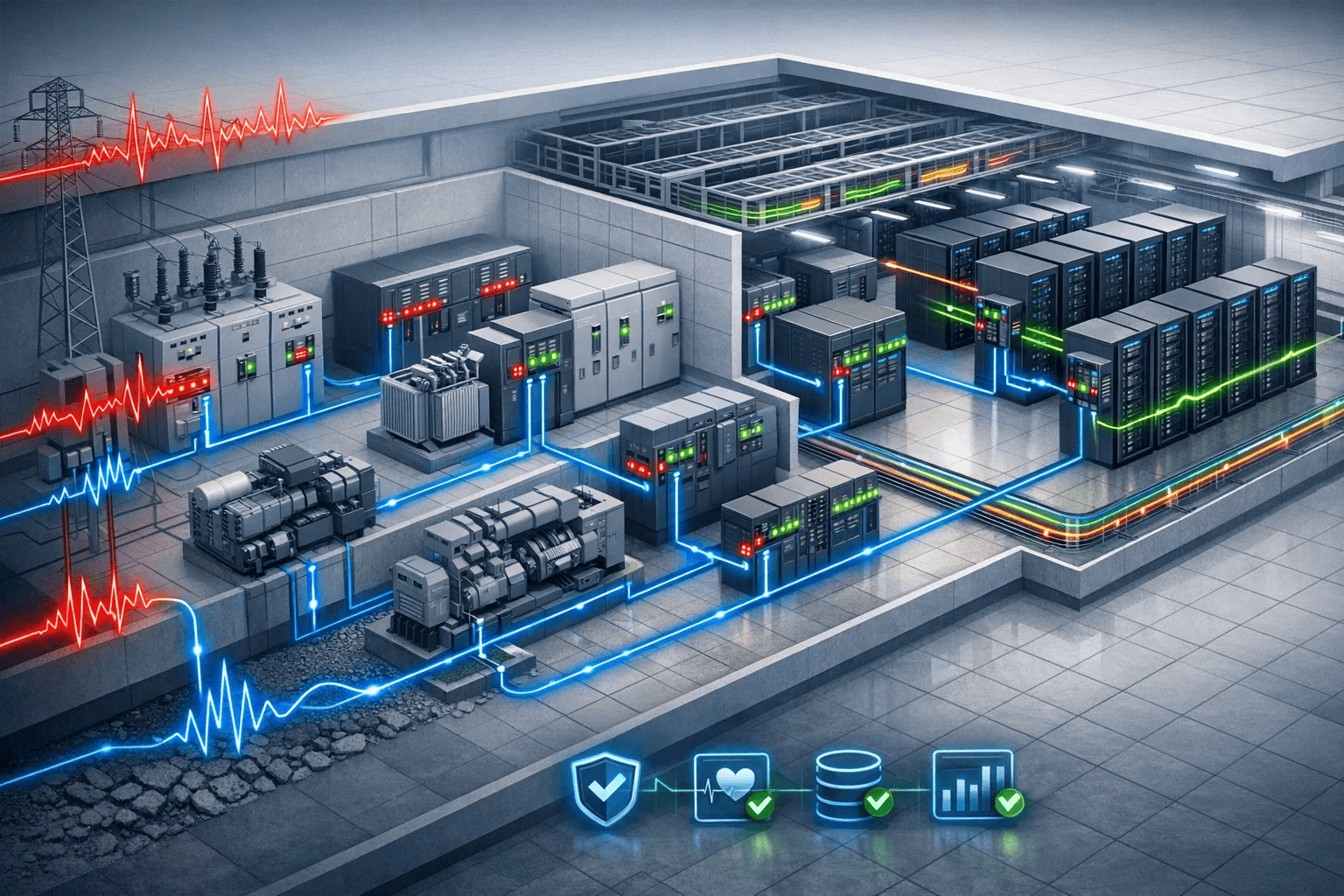
Uptime is designed in megawatts and milliseconds. The protection has to match: an external LPS that keeps lightning current off the roof plant, a bonding network that holds every rack at one potential, and coordinated SPDs from the MV/LV intake down to the rack.
LPZ 0 → 3lightning protection zones stepped down from the roof to the rack, as defined in IEC 62305-4
3 stagesType 1+2 at the intake, Type 2 at UPS and PDU level, Type 3 at sensitive equipment
1 eartha single interconnected earthing system with a meshed bonding network in every technical room
The riskData centre equipment is damaged by voltage differences inside the building, not by a high earth resistance reading.
The LPES answerLPES combines a roof LPS, a TN-S mesh bonding network and Type 1, Type 2 and Type 3 SPDs in coordinated stages.
The ruleIS 3043:2026 makes TN-S with a mesh bonding network mandatory for data centres and does not permit separate clean earths.
LPES protection map Data Centres
Lightning protectionEarthing & bondingSurge protectionSelect a point to see the threat, the LPES measure and the product families.
1Lightning protection
Roof and cooling units
Threat
Direct strikes to rooftop plant and the pipework that leads inside.
LPES measure
Meshed air termination on the roof with rods that place every chiller and AHU inside the protected volume. Separation distance is kept, or the unit is bonded and its cables protected at the zone boundary.
Lightning, earthing and surge risks on data centre sites
Strikes to roof plant
Chillers, dry coolers and AHUs sit on the roof and connect straight into the building by pipe and cable. Unprotected, they bring partial lightning current into the white space.
Potential differences between racks
Low earth resistance alone does not help. Without a meshed bonding network, surge current creates voltage between cabinets and across data ports.
Switching surges inside the power chain
Utility events, generator transfer, STS operation and large chiller motors create transients on both sides of the UPS, every day.
Copper lines that bypass the protection
Perimeter CCTV, gate automation, BMS outstations and carrier entries all cross the zone boundary. One unprotected line undoes the rest.
The LPES answer
One coordinated lightning protection, earthing and surge protection system
Four pillars. Connected protection. Clear accountability.
Lightning protection, earthing and surge protection only work when they are designed together. LPES is the four parts of that system in one name.
Lightning protection
The building steel and reinforcement are used as natural down conductors and connected to a foundation earth electrode. On the roof, a mesh with rods protects the cooling plant. Where separation distance cannot be kept, isolated air termination keeps lightning current away from pipework and cable trays.
Protection only works if the power system lets it. LPES studies the fault levels, neutral earthing, earth-fault loop impedance and protection settings, so that every PE conductor is sized for its fault current and every protective device disconnects in time.
Safety earthing, lightning earthing and telecom bonding are one system, joined at the main earthing terminal. IS 3043:2026 makes TN-S with a mesh bonding network mandatory for data centres. Inside, a meshed bonding network gives surge current many short paths, so no single rack sees the voltage.
SPDs are placed where conductors cross a zone boundary. Type 1+2 at the service entrance, Type 2 through the UPS and PDU chain, Type 3 and data-line SPDs at BMS, EPMS, security and network equipment. Status contacts report to the monitoring system.
Products are available in four series, LPES BASIC, LPES SMART, LPES PRO and LPES CENTURY, so the specification can match the duty and the budget of each area of the site.
Protective conductors
Earthing and PE conductors: what protects people, and what CEA 2023 requires
An electrode in the ground protects nobody on its own. People and equipment are protected by the conductors that join every frame, panel and pipe back to the main earthing terminal. The CEA Safety Regulations 2023 make these connections mandatory. Select a conductor to see the rule, the sizing and the LPES material. The LPES shields mark where lightning, power, earthing and surge protection apply on the plant, down to the SPD type at each level.
Drag to rotate
Auto tour · select any point to stop
Conductor 3 of 5
Protective earthing (PE) conductor
Main earthing terminal to the frame of every piece of equipment
In a data centre. UPS, chillers and room cooling units run 24 × 7. A loose PE leaves a frame live and puts leakage current into the bonding network.
Rule
CEA Reg 43(vii): two separate and distinct connections for apparatus above 250 V. Reg 43(ix): carries the prospective earth-fault current.
Limit
Earth-fault loop impedance: measured Zs ≤ ⅔ × U0 / Ia, so the device disconnects in 0.4 s at 230 V and 0.2 s above 230 V on TN final circuits.
Sizing
IS 3043:2026, Table 12, same material as the line conductor S: equal to S up to 16 mm², 16 mm² for S from 16 to 35 mm², S/2 above 35 mm². Or by the adiabatic equation S = √(I²t) / k.
Material
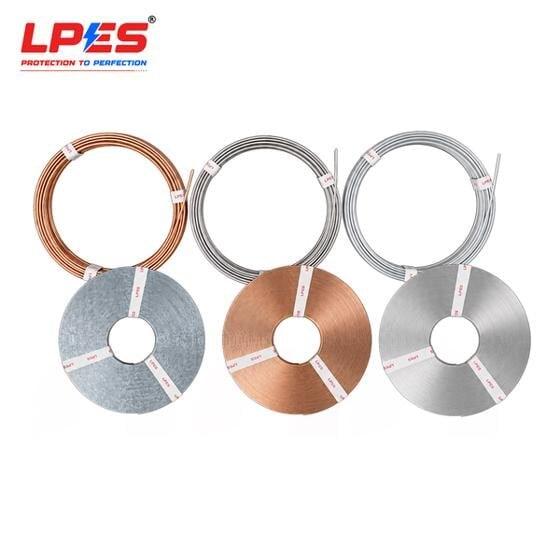
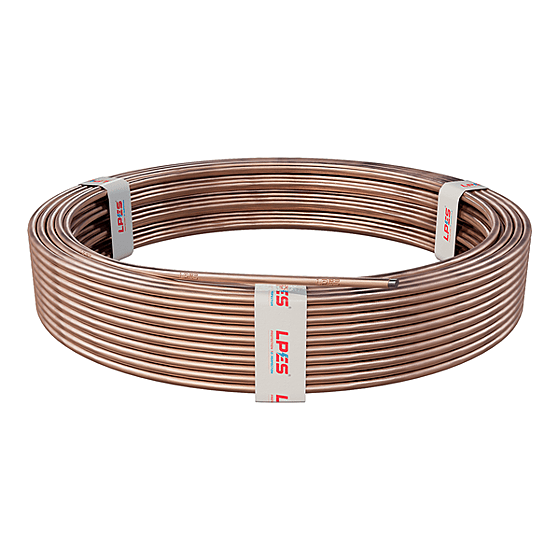
Insulated green-yellow copper cable, copper tape or copper-bonded conductor, with crimped lugs at both ends. No soldered joints and no switch in the PE.
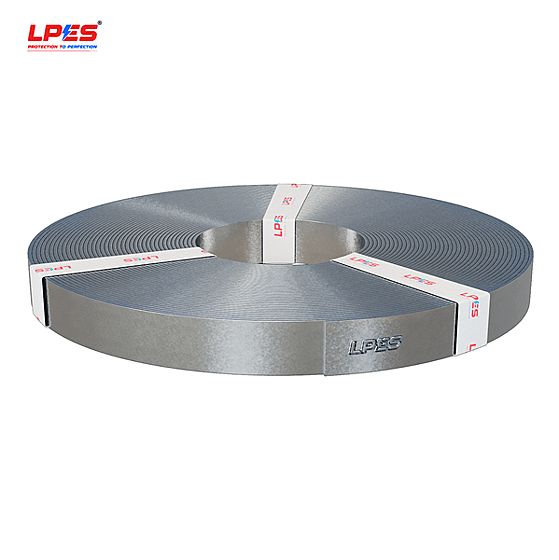
TN-S inside the building: neutral and PE are separate from the main board onward. A PE conductor goes with every feeder to UPS, PDU, busway and rack, sized for the fault level. Where leakage current is high, the PE is reinforced or duplicated. Insulated green-yellow copper is used for PE and bonding, copper tape for the mesh.
Reg 43(v)Every building has protective equipotential bonding that interconnects exposed and extraneous conductive parts.
Reg 43(ix)Bonding conductors carry the prospective earth-fault current and are tested for effective bonding before energisation.
Reg 43(xi), (xii)Earth-fault loop impedance is tested so the protective device disconnects in time.
Reg 43(xiii)The neutral point of every generator and transformer is earthed by not less than two separate connections.
Two points from IS 3043:2026 that change how earthing is specified. At low voltage there is no minimum earth electrode resistance: protection depends on the earth-fault loop impedance and on the protective device tripping in time. And separate “dedicated” or “clean” earth pits for neutral, body, instruments or electronics are not to be used: every electrode joins one interconnected earthing network.
Clause references are to the Central Electricity Authority (Measures relating to Safety and Electric Supply) Regulations, 2023. Sizing lines follow IS 3043:2026 and IS 732:2019. Confirm against the current official text and state notifications before using them in a tender or inspection.
Want this checked against your plant?Send the single line diagram and layout. An LPES engineer reviews earthing, PE conductors and lightning protection against CEA 2023 and IS 3043:2026.
LPS class, SPD rating and conductor sizes for data centre projects
The figures engineers look up most, with the clause behind each. Rows marked in red are specific to data centre sites.
Item
Value
Source
System earthing
TN-S with a mesh bonding network (MESH-BN)
IS 3043:2026, 11.8
Bonding ring to reinforcement
Every 5 m in computer and communication buildings
IEC 62305-3:2024, D.6
Bonding network mesh
Typically 5 m, tied to rebar every 1 to 2 m
IEC 62305-4:2024, 5.3
Separate “clean” earths
Not permitted. One interconnected earthing network
IS 3043:2026, 6.3
Rolling sphere radius
20 / 30 / 45 / 60 m for LPS Class I / II / III / IV
IEC 62305-3:2024, Table 2
Air-termination mesh
5 / 10 / 15 / 20 m for Class I / II / III / IV
IEC 62305-3:2024, Table 2
Down-conductor spacing
10 / 10 / 15 / 20 m for Class I / II / III / IV
IEC 62305-3:2024, Table 5
LPS conductor, minimum
50 mm² in copper, aluminium, galvanised or stainless steel
IEC 62305-3:2024, Table 7
Lightning earth
Ring electrode at least 0.5 m deep, about 1 m from the walls. Aim below 10 Ω
IEC 62305-3:2024, 5.4
Entrance SPD where an LPS exists
Type 1 (Class I). Iimp 25 / 18.75 / 12.5 kA per pole for LPL I / II / III–IV
IEC 62305-4:2024, Table C.3
SPD connecting leads
0.5 m total or less, line to SPD to earth bar
IEC 62305-4:2024, Annex C
Second SPD
Needed when equipment is more than 10 m from the entrance SPD
IEC 62305-4:2024, Annex C
Bonding bar to earth
16 mm² copper, 25 mm² aluminium or 50 mm² steel
IEC 62305-3:2024, Table 9
Disconnection time, TN final circuits
0.4 s at 230 V, 0.2 s above 230 V
IS 3043:2026, Table 1
Loop impedance, measured
Zs ≤ ⅔ × U0 / Ia
IS 3043:2026 and IS 732
PE and bonding continuity
Within the conductor’s own resistance, tested at about 10 A
IS 3043:2026, Annex E
The LPS class and the SPD protection level are set by an IEC 62305-2 risk assessment for the site, not chosen from this table. Values are quoted for reference and must be confirmed against the current edition of each standard at design stage.
Component standards
Every part of the data centre protection system has its own test standard
IEC 62305 sets the design. The IEC 62561 series sets the test for each component that carries lightning current. A system holds only if the clamp, the conductor and the electrode each pass their own test.
Each joint is aged in salt mist and a humid sulphurous atmosphere, then tested with lightning current. Class H is tested at 100 kA and class N at 50 kA.
Joins metal parts that must stay separate in service, such as insulating flanges and cathodically protected pipes. The gap conducts only during a strike.
Sets the size, material, joints and continuity of every protective conductor from the earth electrode to the equipment frame.
IEC 60364-5-54, IS 3043:2026, IS 732:2019
LPES components are built and comply to the parts listed. Ask for the test report of the specific product with your enquiry. Confirm clause values against the current edition of each standard at design stage.
Need the bill of material for your data centre project?Share the drawings and LPES returns a specified, priced list across lightning protection, earthing and surge protection.
Seven stages, from the first risk assessment to the yearly inspection, with clear ownership at every interface.
Calculated. Coordinated. Implemented. Verified.
AssessIEC 62305-2 risk assessment, site audit, soil resistivity survey
DesignLPS, earthing and SPD design with calculations and drawings
SpecifyBill of materials with LPES part numbers and data sheets
SupplyProducts from one source, tested to IEC 62561 and IEC 61643
ImplementInstallation supervision or turnkey execution
VerifyContinuity, earth resistance and SPD checks, recorded
AssurePeriodic inspection, monitoring and AMC
LPES Protection Passport. Every project closes with one document set: risk assessment, as-built drawings, product list with part numbers, test records and the inspection plan.
The applicable edition and any project or statutory specification are confirmed at the design stage.
Questions engineers ask
Data Centres lightning protection and earthing: frequently asked questions
Is a low earth resistance value enough for a data centre?
No. Earth resistance matters for fault clearing and lightning dissipation, but IT equipment is damaged by voltage differences between points inside the building. That is controlled by equipotential bonding: a meshed network with short, low-impedance bonds to every rack and tray. Related: Equipotential Bonding ›
Where should SPDs be installed in the power chain?
At every point where a conductor crosses a lightning protection zone boundary. In practice: Type 1+2 at the main LV switchboards, Type 2 at UPS input, bypass and output and at PDU or RPP level, and Type 3 close to sensitive loads. The stages must be coordinated by voltage protection level and distance. Related: AC Power SPDs ›
How are rooftop chillers protected from direct strikes?
The unit is placed inside the protected volume of air-termination rods using the rolling sphere method, and the separation distance between the LPS and the unit is checked. If it cannot be kept, the unit is bonded to the LPS and its power and control cables get SPDs where they enter the building. Related: Isolated Air-Termination ›
Which protection level does a data centre need?
That is decided by an IEC 62305-2 risk assessment using the building, its contents and the local flash density, not by a rule of thumb. LPES runs the assessment and issues the result with the design basis. Related: Audit & Compliance ›
Engineering guides from the LPES knowledge hub
Data centres: earthing and bonding
ICT: functional earthing and telecommunications bonding networksHB-ID-537
Types of protective earthing conductors and their electrical continuityHB-ID-530
Earthing conductor and protective bonding conductor sizingHB-ID-528
Main earthing terminal / main earth busbar (MET)HB-ID-529
Fault protection by automatic disconnection in TN, TT and IT systemsHB-ID-532
Bring your electrical protection together. Understand your risks. Coordinate your protection. Know who owns each responsibility.
Talk to LPES about a coordinated assessment for your data centre project, from Lightning to Load. You get: a risk assessment and a protection concept, based on your site layout and single line diagram.
In the digital era, data centers are not merely buildings they are the nerve centers of global connectivity, commerce, governance, and innovation. Every second of uptime carries value; every second of downtime carries consequence. Among the many risks data centers face, lightning induced outages and electrical surges remain one of the most underestimated yet destructive threats.
At LPES International, we engineer shield like protection ecosystems that preserve data center uptime, protect critical IT infrastructure, safeguard human lives, and ensure uninterrupted digital continuity using LPES Lightning Protection, Surge Protection, Earthing, and Equipotential Bonding solutions.
Lightning Induced Downtime in Data Centers
When lightning strikes directly or indirectly it does not announce itself. It travels silently through
Power supply lines
Data and communication cables
Earthing systems
Metallic structures and rooftop installations
Even a distant lightning event can cause transient overvoltages and ground potential rise,leading to:
Sudden shutdown of servers and storage systems
Failure of UPS, PDUs, and power distribution panels
Data corruption, packet loss, and networkinstability
Damage to BMS, fire detection, and monitoringsystems
Risk to on site manpower during surge events
For data centers, such downtime results in SLA breaches, financial penalties, reputational damage, andirreversible dataloss. In an industry built on trust and continuity, lightning becomes a business-critical risk.
Core keywords embedded: data center downtime, lightning risk in data centers, electrical surge impact, IT infrastructure failure
Data centers operate with advantages and responsibilities that few industries carry
24/7, mission critical operations
Massive investment in servers, storage, and networking
Dependence on stable power and clean earthing
Responsibility for safeguarding sensitive databases and digital assets
High human concentration in technical and operational zones
However, these strengths also create vulnerabilities. Dense electronics, high speed data flow, and interconnected systems mean that a single surge can cascade across multiple layers of infrastructure vulnerabilities.
This is why data centers require far more than basic lightning rods they demand integrated, engineered electrical protection systems aligned with global best practices.
The LPES Shield: End to End Protection for DataCenters
At LPES International, we provide data centers with a multi layered protection shield, ensuring that lightning energy is intercepted, controlled, equalized, and safely dissipated before it reaches criticalsystems or people.
1. Lightning Protection Systems (LPS)
LPES external lightning protection systems safeguard:
Rooftops, antennas, lightning masts, HVACunits
Metallic structures and exposed installations
By safely capturing and directing lightning energy to earth, our systems prevent direct strike damage, fire hazards, and structural risks.
2. Surge Protection for Power & IT Networks
Our LPES Surge Protection Devices (SPDs) provide layered defense for:
Utility incomers, HT/LT panels, UPS, DG sets
Server racks, PDUs, and power distribution units
Data, fiber, Ethernet, and communication lines
This ensures protection against transient overvoltage, preserving server health, data integrity, and system uptime.
Earthing Systems The Backbone of Stability
LPES designs low resistance, high performance earthing systems that:
Control fault currents and lightning discharge
Stabilize reference voltage for sensitive IT equipment
Enhance effectiveness of SPDs and lightning protection
We provide clean earthing, safety earthing, and functional earthing, tailored to data center requirements.
Databases & IT Fields: data integrity, network uptime Manpower: engineers, operators, maintenance teams
By integrating lightning protection, surge protection, earthing, and bonding, LPES delivers true operational resilience.
LPES Protecting Uptime, Preserving Trust:
For data centers, protection is not optional it is foundational. LPES does not simply install equipment;we engineer assurance, ensuring that your digital infrastructure remains secure against nature’s most unpredictable forces.
LPES International stands as a trusted partner to data centers worldwide shielding data, systems, andpeople, every second, every strike.
Items have been added to cart.
One or more items could not be added to cart due to certain restrictions.