Introduction
Lightning protection design for a newly constructed industrial facility differs significantly from designing protection for an existing operational plant. Although the fundamental engineering principles remain the same, site conditions, installation constraints, electrical infrastructure and operational requirements influence the overall protection strategy.
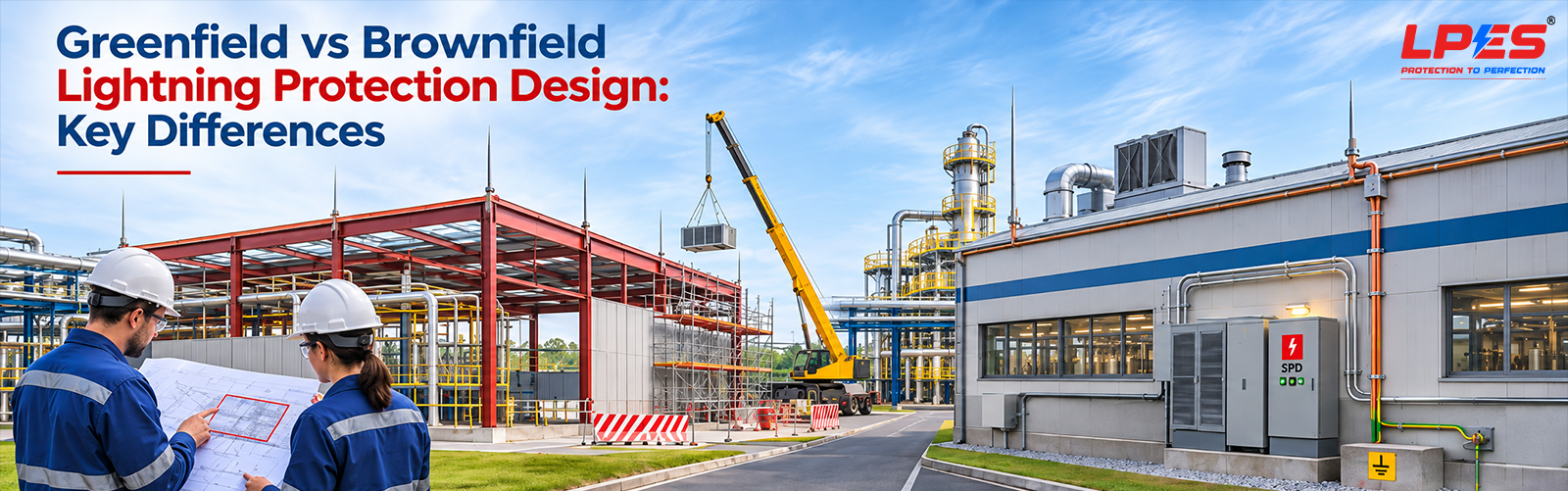
Greenfield projects allow engineers to integrate lightning protection systems into the facility from the initial planning stage. Brownfield projects require engineers to work around existing structures, machinery, electrical installations and ongoing operations.
Understanding the differences between greenfield and brownfield lightning protection design helps project teams make better engineering decisions, reduce installation challenges and maintain electrical safety throughout the facility's operational life.
What Is Greenfield Lightning Protection Design?
A greenfield project involves developing a new facility on a previously undeveloped site or constructing a new installation from the ground up.
In such projects, lightning protection can be incorporated during architectural, structural, civil and electrical design stages.
Engineers have greater flexibility to determine air-terminal locations, down conductor routes, underground earthing networks, equipotential bonding arrangements and surge protection requirements before construction begins.
For a new manufacturing plant, foundation earthing, structural bonding and underground conductors can be coordinated before concrete pouring and equipment installation. This reduces unnecessary excavation and structural modifications later.
What Is Brownfield Lightning Protection Design?
A brownfield project involves upgrading, expanding or modifying an existing facility.
Unlike greenfield developments, brownfield projects must accommodate established infrastructure, operational machinery, underground utilities and existing electrical systems.
The engineering process typically begins with a detailed site inspection to determine the condition, suitability and limitations of the existing protection system.
For example, an operational chemical processing plant may have congested pipe racks, storage tanks, restricted access areas and ageing earthing connections. Installing additional lightning protection components requires careful coordination with these conditions.
Existing components should be retained only when their condition, suitability and performance can be adequately verified.
Key Differences Between Greenfield and Brownfield Lightning Protection Design
Design Parameter | Greenfield Projects | Brownfield Projects |
Design flexibility | Greater flexibility | Restricted by existing infrastructure |
Site assessment | Proposed layouts and site conditions | Detailed inspection of existing installations |
Earthing systems | Planned before construction | Existing network evaluated and upgraded |
Down conductor routing | Integrated into structural design | Adapted to available installation routes |
Surge protection | Planned during panel design | Retrofitted or upgraded within existing panels |
Installation access | Generally easier during construction | Often restricted by ongoing operations |
Operational interruption | Typically limited before commissioning | May require planned shutdowns |
Documentation | Developed from the design stage | Existing records verified and updated |
These differences influence engineering decisions, installation methodology, project schedules and maintenance requirements.
Engineering Considerations for Greenfield and Brownfield Projects
1. Lightning Risk Assessment
Both project types require lightning risk assessment based on structural characteristics, lightning exposure, occupancy, connected services and potential consequences.
In greenfield projects, the assessment is based on proposed facility layouts and planned operations. It should be updated when significant design changes occur.
For brownfield facilities, engineers must consider actual site conditions, existing protection measures, modifications and operational dependencies.
A manufacturing plant that has expanded over several years may have risks that were not considered in its original design.
2. External Lightning Protection Systems
Greenfield projects allow air-termination networks and down conductors to be coordinated with roof geometry, structural columns and architectural features.
Engineers can evaluate protection coverage using the rolling sphere, protective angle or mesh method, as applicable.
Brownfield projects may have additional rooftop equipment, ventilation ducts, exhaust stacks, solar installations and metallic services that interfere with existing protection arrangements.
Engineers must reassess protection coverage, conductor routing and separation distances before selecting suitable modifications.
3. Earthing and Grounding Systems
Earthing infrastructure is one of the most significant differences between greenfield and brownfield projects.
In greenfield developments, soil resistivity testing and earthing design can be completed before foundation construction. Underground conductors, electrodes and bonding connections can be installed in coordination with civil activities.
Brownfield projects may involve incomplete earthing drawings, corroded connections, inaccessible electrodes and congested underground services.
Continuity testing, earth resistance measurements and physical inspections help establish the condition of the existing network. Additional electrodes or conductors should be introduced according to engineering requirements rather than simply increasing the number of earth pits.
4. Surge Protection Solutions
Greenfield projects provide opportunities to incorporate surge protection devices into electrical panels during their initial design.
Protection can be coordinated across incoming power supplies, distribution boards, PLC panels, instrumentation systems and communication networks.
In brownfield projects, installing SPDs may be challenging because of limited panel space, existing wiring arrangements and operational shutdown restrictions.
Engineers should review the electrical system configuration, prospective short-circuit current, equipment voltage withstand levels, backup protection and SPD connection lengths.
Type 1, Type 2 and Type 3 SPDs should be selected and coordinated according to their application and protection requirements.
5. Equipotential Bonding
Greenfield projects allow bonding connections for structural steel, metallic pipelines, cable trays and electrical equipment to be planned before installation.
Brownfield facilities may contain disconnected metallic structures, undocumented bonding connections or equipment installed during previous expansion activities.
Existing connections should be inspected and tested. New bonding arrangements must consider lightning current paths, electrical safety and special requirements associated with hazardous areas or cathodically protected infrastructure.
Installation Planning and Operational Challenges
Greenfield installations can be scheduled alongside civil, structural and electrical construction activities. Inspection hold points can be established before underground or concealed components become inaccessible.
Brownfield installations require additional attention to operational safety and execution planning.
Typical considerations include:
Permit-to-work and electrical isolation requirements.
Excavation clearance and underground utility identification.
Working at height near operating equipment.
Hot work restrictions in hazardous process areas.
Planned shutdowns for electrical panel modifications.
Maintaining necessary protection during phased installation.
Effective coordination between engineering, maintenance, production and safety teams is particularly important when modifying an operational facility.
Engineering Documentation and Applicable Standards
Both greenfield and brownfield lightning protection systems should be designed according to applicable engineering standards and project requirements.
Relevant standards include:
IEC 62305-1: General principles of lightning protection.
IEC 62305-2: Lightning risk management.
IEC 62305-3: Protection of structures and reduction of associated life hazards.
IEC 62305-4: Protection of internal electrical and electronic systems.
IEC 62561 series: Lightning protection system component requirements.
IEC 61643 series: Surge protective devices and relevant application principles.
AutoCAD-based lightning protection design supports the development of protection layouts, conductor routes, bonding details and earthing drawings.
For brownfield facilities, drawings must also distinguish existing components, proposed additions, replacements and items identified for removal.
Following installation, visual inspections, continuity testing, earth resistance measurements and SPD verification should be performed as applicable. Final as-built documentation should accurately represent the completed system.
Benefits of a Project-Specific Protection Strategy
An engineering approach tailored to the project type can help reduce equipment damage, improve personnel safety and limit lightning-related operational disruptions.
For greenfield projects, early protection planning can reduce construction rework and improve coordination between engineering disciplines.
For brownfield projects, targeted upgrades can improve protection while allowing suitable existing infrastructure to remain in service.
Both approaches support long-term electrical reliability and operational continuity.
About LPES International
LPES International provides engineering-focused lightning protection systems, surge protection solutions, earthing and grounding systems, equipotential bonding, lightning risk assessment and technical consultation.
Its connected engineering approach addresses protection requirements from initial assessment and design through implementation, inspection and verification. For industrial facilities, coordinated engineering drawings and documented installation records support effective project handover and long-term electrical safety management.
Why Choose LPES International?
Engineering-focused expertise: Evaluating protection requirements according to actual facility conditions.
Customized protection design: Developing solutions around project-specific structural and electrical constraints.
Risk-based planning: Selecting protection measures based on identified risks.
Quality-focused material selection: Considering electrical performance, mechanical strength and environmental exposure.
Technical project support: Supporting design coordination, implementation, inspection and verification.
Conclusion
Greenfield and brownfield lightning protection design requires different engineering and execution approaches. New facilities benefit from early design integration, while existing plants require detailed assessment, infrastructure verification and careful installation planning.
Regardless of the project type, effective lightning protection depends on risk assessment, external protection systems, coordinated surge protection, earthing and equipotential bonding.
Contact LPES International for technical consultation and engineered lightning protection solutions tailored to greenfield developments, brownfield upgrades and industrial expansion projects.