
Introduction
Industrial and manufacturing facilities depend on reliable electrical infrastructure to maintain production, personnel safety and operational continuity. Lightning strikes can damage electrical equipment, disrupt automated processes and create serious safety hazards when protection systems are inadequate or poorly maintained.
Although a Lightning Protection System (LPS) provides a controlled path for lightning current, its condition must be verified throughout its service life. Facility managers need to know when the system may have experienced a lightning event and whether additional inspection is required.
Lightning strike counters support this process by recording qualifying impulse current events in monitored conductors. These records help maintenance teams identify potential lightning activity, plan inspections and maintain a documented history of the protection system. When integrated with periodic inspection, electrical testing and preventive maintenance, strike counters provide useful information for managing lightning-related risks.
What Is a Lightning Strike Counter?
A lightning strike counter is a monitoring device designed to register impulse current events flowing through a selected conductor within a lightning protection system or another suitable current path.
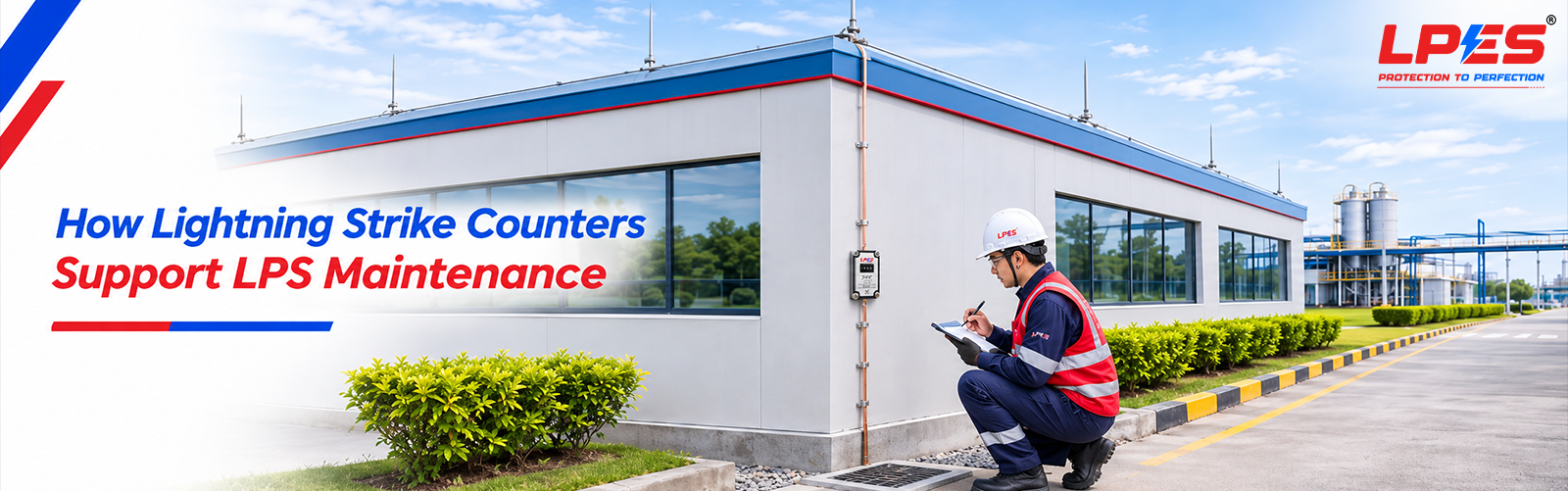
It is commonly installed on an external LPS down conductor, where it detects qualifying current impulses travelling towards the earth termination system.
Depending on the device, a lightning strike counter may provide:
Cumulative lightning impulse count.
Date and time of recorded events.
Impulse current magnitude information in advanced monitoring systems.
Local digital or mechanical display.
Remote monitoring and communication capabilities.
A conventional strike counter does not intercept lightning, limit transient voltages or improve earth resistance. Its primary function is monitoring and recording.
Lightning Risks in Industrial and Manufacturing Facilities
Manufacturing facilities often include large metal-roof buildings, chimneys, rooftop ventilation equipment, transformers, utility structures and extensive electrical distribution networks.
Direct or nearby lightning strikes can affect these facilities through physical damage, electromagnetic coupling and transient overvoltages.
Sensitive equipment exposed to lightning-related disturbances includes:
Programmable Logic Controllers (PLCs).
Variable Frequency Drives (VFDs).
Motor Control Centres (MCCs).
Transformers and electrical distribution panels.
SCADA and industrial communication systems.
Automated production machinery.
Fire detection and security systems.
Lightning current can also subject conductors, clamps and connections to thermal and mechanical stresses. Existing corrosion, loose connections or damaged components may further compromise system performance.
Strike monitoring provides maintenance teams with an additional indication of when these components may require inspection.
How Do Lightning Strike Counters Work?
When lightning current flows through a monitored conductor, it produces a magnetic field around that conductor. Many lightning strike counters use electromagnetic sensing to detect the resulting impulse.
When the detected current satisfies the device's specified operating criteria, the counter registers an event.
Some counters operate without an external power supply, while advanced electronic devices may use batteries or an auxiliary supply for event storage, timestamps and communication.
In facilities with multiple down conductors, lightning current can divide between several parallel paths. A counter installed on one conductor may therefore not register every strike affecting the structure.
The detection threshold, current waveform, installation arrangement and counter specifications must be considered when interpreting recorded events.
How Lightning Strike Counters Support LPS Maintenance
1. Identify the Need for Post-Strike Inspections
Lightning events may occur outside working hours or during periods when no personnel are present near the affected structure.
An increase in the counter reading provides a reason to investigate possible lightning activity and assess whether the protection system requires additional inspection.
2. Support Preventive Maintenance Planning
Maintenance teams can use strike records alongside previous inspection reports, environmental conditions and equipment condition to establish maintenance priorities.
Structures showing repeated recorded events may warrant additional attention based on their exposure, operational importance and inspection findings.
3. Maintain Lightning Event Records
Documented counter readings provide a historical record of detected impulse events.
Advanced counters with timestamps allow engineers to compare recorded events with production interruptions, electrical alarms, SPD indications and equipment failures.
This information can support root cause investigations, although a recorded event alone does not establish the cause of equipment damage.
4. Improve Maintenance Documentation
Strike counter records can be incorporated into maintenance reports, asset registers and electrical safety documentation.
These records help facility managers track inspections, corrective actions and the condition of lightning protection systems over time.
Post Strike LPS Inspection Checklist
When a new event is recorded or a lightning strike is suspected, qualified maintenance personnel should assess the protection system once weather and site conditions are safe.
Component | Recommended Inspection |
Air termination system | Check rods, roof conductors and supports for damage or displacement. |
Down conductors | Inspect for mechanical damage, corrosion and loose fixings. |
Clamps and connections | Check for overheating, deterioration and connection integrity. |
Earthing systems | Conduct appropriate earth resistance testing and compare results with previous records. |
Equipotential bonding | Verify bonding connections and electrical continuity where required. |
Surge protection devices | Check status indicators, remote alarms and manufacturer-recommended inspection requirements. |
Lightning strike counter | Record the reading and verify its mounting, display and condition. |
Any identified defects should be documented, evaluated and corrected according to the approved maintenance procedure.
Installation and Selection Considerations
Lightning strike counters should be selected according to the facility's lightning protection design and monitoring requirements.
Important considerations include:
Minimum detectable impulse current.
Maximum specified counting current and impulse waveform.
Compatibility with round or flat conductors.
Environmental protection and enclosure rating.
Accessibility for inspection and reading.
Local or remote monitoring requirements.
Counter locations should be identified on the LPS drawings. Installation must follow manufacturer instructions without compromising conductor continuity, separation distances or mechanical integrity.
For facilities with several down conductors, monitoring locations should be selected according to the current distribution arrangement and maintenance objectives.
Integrating Strike Counters with Lightning Protection Solutions
Strike monitoring is most useful when incorporated into a coordinated protection strategy:
External Lightning Protection: Air termination systems, down conductors and earth termination systems provide designated paths for lightning current.
Surge Protection Solutions: Coordinated surge protection devices help limit transient overvoltages affecting power, communication and control circuits.
Earthing and Grounding Systems: Properly designed grounding networks support current dissipation and potential control.
Equipotential Bonding: Bonding reduces dangerous potential differences between conductive parts.
Lightning Risk Assessment and Design: Risk assessment establishes appropriate protection measures, while AutoCAD-based engineering drawings can document conductor routes, counter locations and inspection points.
Standards and Engineering Considerations
Relevant international standards include:
IEC 62561-6:2023: Requirements and testing of lightning strike counters.
IEC 62305-2:2024: Lightning risk management.
IEC 62305-3:2024: Physical protection of structures, inspection and LPS maintenance.
IEC 62305-4:2024: Protection of electrical and electronic systems within structures.
IEC 61643 series: Requirements applicable to surge protection devices.
Applicable national standards, project specifications and regulatory requirements should also be considered.
A zero counter reading does not establish that the facility has experienced no lightning activity. Similarly, a recorded event does not confirm that the LPS operated correctly.
Periodic inspections, continuity testing and earthing measurements remain necessary regardless of the recorded strike count.
About LPES International
LPES International is an engineering centered firm that delivers the necessary lightning protection system, surge protection solutions, earthing and grounding systems together with lightning risk assessment and a protection design based on AutoCAD for industrial, commercial, and infrastructure facilities.
Why Choose LPES International?
Engineering Expertise: Protection planning based on electrical infrastructure and site conditions.
Customized Design: System layouts developed around facility geometry and operational requirements.
Risk-Based Planning: Protection measures selected through technical assessment.
Quality Focused Material Selection: Components specified according to electrical, mechanical and environmental requirements.
Technical Consultation: Engineering support for design, installation, inspection and maintenance.
Conclusion
Lightning strike counters provide useful event information for maintaining lightning protection systems in industrial facilities. They support post-strike inspections, preventive maintenance, fault investigations and technical documentation.
However, effective electrical safety and operational continuity depend on coordinated lightning protection, surge protection, earthing, equipotential bonding and periodic system verification.
Contact LPES International for lightning risk assessment, engineered protection design, LPS inspection and maintenance solutions tailored to your facility.