
Introduction
Industrial manufacturing facilities depend on electrical infrastructure, automated machinery, control panels and communication networks to maintain production. These systems are frequently exposed to transient overvoltages caused by lightning activity, electrical switching and disturbances within power distribution networks.
While Surge Protection Devices (SPDs) help limit transient overvoltages, facility engineers also need information about how frequently their electrical systems experience such disturbances.
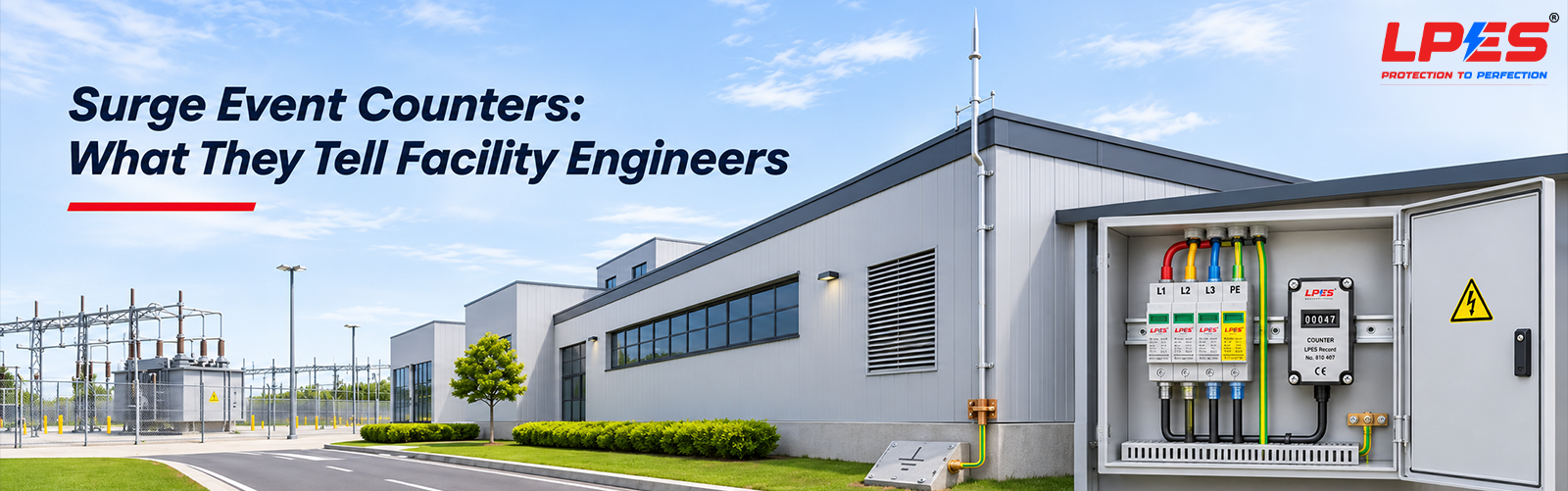
Surge event counters provide this information by recording detected surge events. When interpreted alongside equipment condition, maintenance records and operational data, these readings help engineers identify exposure patterns, investigate electrical disturbances and plan preventive maintenance.
What Are Surge Event Counters?
A surge event counter is a monitoring device designed to register transient electrical events that meet predefined detection criteria.
Depending on the design, the counter may be integrated into a surge protection device or installed as a separate monitoring component within the electrical protection system.
Some counters detect surge currents flowing through a monitored conductor, while others respond to transient voltage conditions.
Basic counters display the accumulated number of detected events. Advanced monitoring systems may provide additional information, including:
Date and time of individual events.
Surge current magnitude.
Event frequency and distribution.
Remote monitoring and event notifications.
Estimated SPD condition, where supported.
Unlike an SPD, a surge event counter does not provide surge protection by itself. Its primary purpose is monitoring and recording electrical disturbances.
Common Sources of Surge Events in Industrial Facilities
Lightning is an important source of electrical surges, but it is not the only one. Manufacturing facilities contain several electrical systems capable of generating transient disturbances during normal or abnormal operations.
Common sources include:
Direct and nearby lightning strikes.
Transformer energization.
Capacitor bank switching.
Switching of inductive electrical loads.
Utility network switching operations.
Electrical fault clearing and circuit interruptions.
These disturbances can affect programmable logic controllers (PLCs), variable frequency drives (VFDs), instrumentation, industrial communication networks and machine control systems.
Even when equipment does not fail immediately, repeated electrical stress can contribute to component degradation, unexpected malfunction and production interruptions.
What Surge Event Counters Tell Facility Engineers
1. Frequency of Electrical Disturbances
Surge counters provide a record of detected transient activity within a monitored section of the electrical installation.
An increasing count may indicate repeated exposure to electrical disturbances. Comparing readings over consistent inspection intervals helps engineers establish whether surge activity is changing.
2. Exposure During Lightning Seasons
Manufacturing facilities in regions with frequent thunderstorms may experience increased surge activity during certain periods.
Comparing counter readings with weather records and lightning activity can help identify possible relationships between external conditions and electrical disturbances.
However, an increase in surge count does not automatically confirm a direct lightning strike.
3. Areas Requiring Further Investigation
Counters installed at different distribution levels can help engineers identify locations experiencing frequent detected disturbances.
For example, repeated events recorded near a motor control centre may justify investigating switching operations, connected machinery and local surge protection arrangements.
Comparisons should consider differences in counter sensitivity, detection thresholds and monitoring locations.
4. Preventive Maintenance Requirements
An unusual increase in recorded events provides a reason to inspect the associated surge protection devices, electrical connections and earthing arrangements.
Rather than waiting for equipment failure, maintenance teams can investigate potential issues during planned maintenance activities.
5. Possible Causes of Equipment Interruptions
Time stamped surge records can be compared with PLC alarms, drive faults, production stoppages and communication failures.
Although this does not establish the cause of every interruption, it provides additional evidence for electrical fault investigations.
Surge Event Counters vs Lightning Strike Counters
Although both devices record electrical events, their monitoring applications are different.
Parameter | Surge Event Counter | Lightning Strike Counter |
Primary purpose | Monitor detected electrical surges | Record detected lightning current impulses |
Typical location | Electrical panels or SPD installations | Lightning protection conductors |
Event sources | Lightning-related and switching transients | Lightning-related current impulses |
Application | Internal electrical protection monitoring | Lightning protection system monitoring |
Maintenance focus | SPD and electrical system investigation | Lightning protection system inspection |
The correct counter must be selected according to the intended monitoring application and detection characteristics.
Where Should Surge Event Counters Be Installed?
Monitoring locations should reflect the facility's electrical distribution architecture and equipment criticality.
Typical locations include:
Main low voltage distribution panels.
Motor control centres.
Critical process control panels.
Distribution boards supplying automated production lines.
Electrical panels supplying sensitive instrumentation.
Counter installation should follow manufacturer instructions without compromising SPD connections, conductor routing or electrical safety requirements.
Understanding the Limitations of Surge Event Counters
A high surge count does not necessarily mean that an SPD has reached the end of its service life. Similarly, a low or zero count does not confirm that the electrical system is adequately protected.
A basic counter cannot independently determine surge energy, equipment damage, remaining SPD life or the exact source of a disturbance.
Facility engineers should evaluate counter readings alongside:
SPD condition indicators and remote status contacts.
Earthing and bonding inspection records.
Manufacturer-specific maintenance recommendations.
Power quality monitoring data.
Electrical equipment failure and maintenance history.
There is no universal surge count at which every SPD must be replaced. Replacement decisions should depend on the device's condition, design and manufacturer guidance.
Integrating Surge Monitoring with Electrical Protection Systems
Surge monitoring delivers greater practical value when incorporated into a coordinated electrical protection strategy.
External lightning protection systems: Provide a designed current path for direct lightning strikes through air termination systems, down conductors and earth termination systems.
Surge protection devices: Appropriately coordinated Type 1, Type 2 and Type 3 SPDs limit transient overvoltages at relevant distribution levels.
Earthing systems and equipotential bonding: Provide suitable current paths and help reduce hazardous potential differences during electrical disturbances.
Lightning risk assessment: Identifies lightning exposure, potential consequences and appropriate protection requirements.
Engineering design: AutoCAD based layouts and electrical drawings document SPD locations, earthing connections, protection zones and monitoring points for installation and maintenance.
Standards and Engineering Considerations
Surge protection and monitoring arrangements should be evaluated against applicable standards, including:
IEC 62305-2: Lightning risk management.
IEC 62305-4: Surge protection measures for electrical and electronic systems within structures.
IEC 61643-11: Requirements and test methods for AC low voltage surge protective devices.
IEC 62561-6: Requirements for lightning strike counters, where applicable to the selected device.
Proper documentation, device selection, installation verification and periodic inspection remain essential. Counter readings supplement these activities rather than replace them.
About LPES International
LPES International is an engineering centered firm that delivers the necessary lightning protection system, surge protection solutions, earthing and grounding systems together with lightning risk assessment and a protection design based on AutoCAD for industrial, commercial, and infrastructure facilities.
Why Choose LPES International?
Engineering Expertise: Protection planning based on electrical infrastructure and equipment requirements.
Customized Design: Solutions developed around facility layouts and operating conditions.
Risk-Based Planning: Protection measures selected according to identified electrical and lightning risks.
Quality Focused Material Selection: Components evaluated against relevant technical specifications.
Technical and Project Support: Assistance with assessment, design, installation and inspection.
Conclusion
Surge event counters give facility engineers valuable information about detected transient activity within electrical installations. Their readings can support maintenance planning, disturbance investigations and more informed protection decisions.
However, effective electrical safety and operational continuity depend on coordinated surge protection solutions, lightning protection systems, earthing, grounding and periodic system verification.
For technical consultation, lightning risk assessment or engineered electrical protection solutions for industrial facilities, contact LPES International.