
Introduction
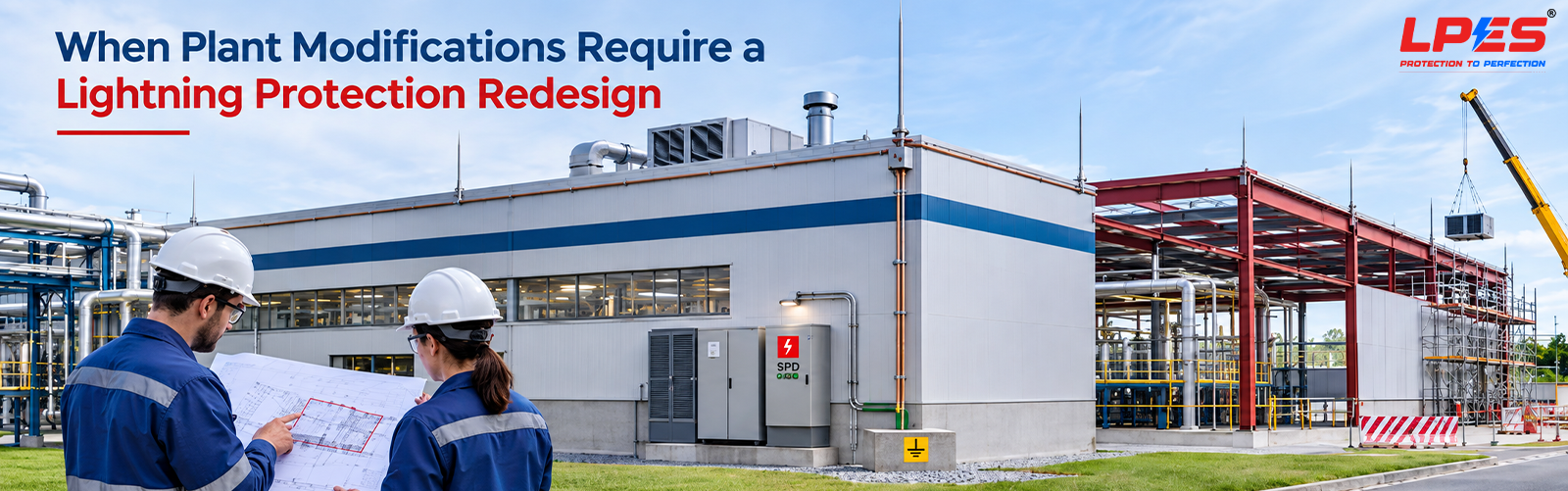
Industrial plants frequently undergo modifications to increase production capacity, accommodate new machinery, improve automation and support changing operational requirements. These modifications may include building extensions, rooftop equipment installation, additional production lines, electrical infrastructure upgrades and changes to process areas.
However, changes to a facility can affect the effectiveness of its existing lightning protection system (LPS). A system designed for the original plant configuration may no longer provide adequate protection after structural or electrical modifications. A lightning protection redesign helps identify newly exposed areas, assess changes in lightning risk and maintain effective protection against equipment damage, fire hazards, electrical surges and operational interruptions.
Why Plant Modifications Change Lightning Protection Requirements
Lightning protection systems are designed according to specific structural dimensions, building geometry, electrical infrastructure, environmental exposure and operational risks.
When these conditions change, the original engineering assumptions may no longer remain valid.
For example, installing a new exhaust stack above a manufacturing building may introduce an exposed point outside the existing air-termination protection zone. Similarly, extending a production building may create roof sections without adequate lightning protection coverage.
Electrical modifications can also introduce additional pathways through which transient surges enter sensitive equipment. Without an engineering review, these changes may expose PLCs, variable frequency drives, electrical panels, communication networks and industrial machinery to increased lightning related risks.
Plant Modifications That Require a Lightning Protection Review
1. Building Extensions and Structural Expansion
Adding production halls, warehouses, utility buildings or additional floors changes the overall geometry of a facility.
Existing air terminals and roof conductor networks may not adequately protect the expanded structure. Down conductor arrangements, separation distances and earth termination systems may also require modification.
Protection coverage should be recalculated according to the revised building dimensions.
2. Installation of New Rooftop Equipment
Industrial rooftops frequently accommodate equipment such as:
HVAC units and ventilation systems
Exhaust stacks and chimneys
Solar photovoltaic systems
Communication antennas
Cooling equipment
Metallic pipelines
New equipment may extend beyond existing protection zones or introduce conductive paths close to lightning protection conductors.
Engineers should reassess air-termination coverage, separation distances, bonding requirements and potential surge entry points.
3. Addition of New Production Lines
Production expansion often involves installing machinery, robotic systems, PLC panels, sensors and motor control centres.
Although these additions may not change the building structure, they can alter electrical distribution arrangements and increase dependence on sensitive electronic systems.
Existing surge protection devices (SPDs) should be reviewed for suitability, coordination and protection of newly installed equipment.
4. Changes to Electrical Distribution Systems
Installing additional transformers, distribution panels, generators or power cables can change how lightning-induced surges propagate throughout a facility.
A protection review should examine incoming electrical services, SPD locations, equipment voltage withstand levels, earthing connections and coordination between upstream and downstream protection devices.
5. Modification of Earthing Infrastructure
Excavation, foundation construction, underground utility installation and civil expansion can damage or disconnect existing buried earthing conductors.
Even when the external lightning protection system appears intact, changes below ground may affect lightning current distribution.
Earth continuity testing, resistance measurements and inspection of accessible connections help determine whether repairs or extensions are necessary.
6. Installation of Storage Tanks and Hazardous Process Areas
Adding chemical storage tanks, fuel handling facilities, flammable material storage or hazardous process equipment can significantly change the consequences of a lightning strike.
These modifications require particular attention to ignition risks, hazardous area classification, separation distances and equipotential bonding.
A revised lightning risk assessment should determine the appropriate protection measures before the modified area becomes operational.
7. Changes to Cable Routes and Communication Networks
New cable trays, instrumentation cables, CCTV networks and communication systems may create additional surge entry paths between buildings or protection zones.
Engineers should review cable routing, shielding, bonding and surge protection for both power and signal circuits.
Protecting electrical power supplies alone may leave sensitive control equipment vulnerable through communication connections.
How to Plan a Lightning Protection Redesign
A redesign should begin during the engineering stage of a plant modification rather than after construction is completed.
Review Existing Protection Documentation
Collect the original lightning risk assessment, as-built drawings, earthing layouts, electrical single-line diagrams and previous inspection reports.
Compare these documents with the proposed plant modifications and actual site conditions.
Conduct a Revised Lightning Risk Assessment
Evaluate changes in structural dimensions, occupancy, process hazards, incoming services and the consequences of equipment failure.
The assessment helps determine whether the existing protection level remains suitable or additional measures are necessary.
Recalculate External Lightning Protection Coverage
Review air termination arrangements using appropriate design methods, including the rolling sphere, protective angle or mesh method.
Check down conductor locations, separation distances and connections to the earth termination system.
Review Surge Protection and Equipotential Bonding
Evaluate protection requirements for new electrical panels, automation systems and communication networks.
Select and coordinate Type 1, Type 2 and Type 3 SPDs where required. Review bonding connections between new metallic installations, structural steel and the existing grounding system.
Update Engineering Drawings
AutoCAD based lightning protection design allows engineers to document revised conductor routes, air terminal positions, earthing connections and equipment interfaces.
Updated drawings also support installation coordination, material planning and future maintenance.
Does Every Plant Modification Require a Complete Redesign?
Not every modification requires replacement or complete redesign of the existing lightning protection system.
Minor changes may only require an inspection, localized bonding improvements or additional surge protection. Major structural expansion, changes in hazardous operations or significant alterations to protection coverage may require a broader redesign.
The decision should be based on engineering assessment rather than the physical size or cost of the modification alone.
Standards and Engineering Considerations
Lightning protection redesign should consider applicable standards and project specific requirements, including:
IEC 62305-2: Lightning risk management.
IEC 62305-3: External lightning protection, structural protection and personnel safety.
IEC 62305-4: Protection of electrical and electronic systems against lightning electromagnetic effects.
IEC 62561 series: Requirements for lightning protection system components.
IEC 61643 series: Requirements and application guidance for surge protective devices.
Applicable national earthing standards and hazardous area requirements should also be considered.
Following installation, inspection, continuity testing, earth resistance measurements and SPD verification should be completed as applicable. Revised as built documentation should reflect the final installed arrangement.
Benefits of Reviewing Lightning Protection During Plant Modifications
Integrating lightning protection engineering into plant expansion projects can provide several operational benefits:
Reduced exposure of newly installed equipment to lightning damage.
Improved electrical safety and personnel protection.
Reduced risk of automation and communication system failures.
Better coordination between existing and new grounding systems.
Reduced potential for unplanned production downtime.
Improved long term reliability and operational continuity.
Early engineering coordination can also reduce avoidable rework after construction.
About LPES International
LPES International provides engineering focused lightning protection systems, surge protection solutions, earthing and grounding systems, equipotential bonding, lightning risk assessment and technical consultation.
Its connected engineering approach addresses protection requirements from initial assessment and design through implementation, inspection and verification. For industrial facilities, coordinated engineering drawings and documented installation records support effective project handover and long term electrical safety management.
Why Choose LPES International?
Engineering focused expertise: Evaluating existing protection arrangements and identifying technical gaps.
Customized protection design: Developing solutions around revised plant layouts and equipment requirements.
Risk-based planning: Identifying protection measures according to facility exposure and operational consequences.
Quality focused material selection: Selecting components according to electrical, mechanical and environmental requirements.
Technical consultation and project support: Supporting design coordination, installation planning, inspection and verification.
Conclusion
Plant modifications can introduce lightning protection gaps that were not present during the original facility design. Structural expansion, new rooftop installations, electrical upgrades and changes to earthing infrastructure should therefore include a documented protection review.
A technically justified lightning protection redesign, supported by risk assessment, coordinated surge protection and effective grounding, helps maintain electrical safety and operational reliability as industrial facilities evolve.
Contact LPES International for technical consultation, lightning risk assessment and engineered protection solutions for existing plants, expansion projects and industrial modifications.