Introduction
Industrial and manufacturing facilities depend on reliable electrical infrastructure to maintain production, equipment performance and personnel safety. Lightning strikes and transient electrical surges can damage machinery, interrupt control systems, create fire hazards and cause unexpected operational downtime. Although considerable attention is given to designing and installing lightning protection systems, documenting the completed installation is equally important.
As built documentation provides an accurate record of how lightning protection, earthing, equipotential bonding and surge protection systems have been installed at a facility. It establishes a technical reference for inspection,
testing, maintenance, troubleshooting and future infrastructure development. Without accurate documentation, facility engineers may struggle to assess whether the installed protection system continues to meet its original engineering objectives.
What Is As Built Documentation in Lightning Protection?
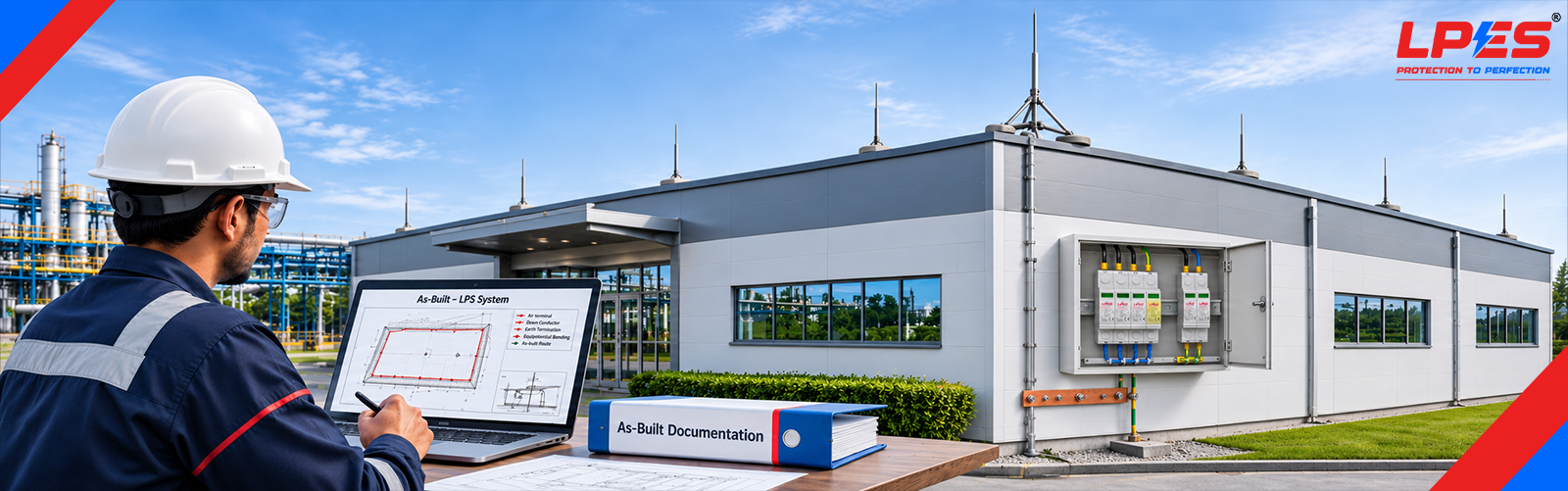
As-built documentation is a collection of technical drawings, installation records, equipment details, inspection reports and test results that represent the actual condition of a completed installation.
Unlike initial design drawings, which describe the proposed installation, as-built drawings reflect what has physically been installed at the site.
During construction, changes may occur because of structural modifications, underground utilities, equipment relocation, installation constraints or coordination with other engineering services.
These changes must be technically reviewed and incorporated into the final documentation.
Design Drawings | As-Built Drawings |
Represent the proposed installation | Represent the actual installation |
Prepared before construction | Finalized following installation and verification |
Show planned conductor routes | Show installed conductor routes |
Support installation planning | Support inspection and maintenance |
Reflect design requirements | Record approved site modifications |
Why As Built Documentation Is Important for Industrial Facilities
Manufacturing facilities contain interconnected electrical and electronic equipment, including transformers, motor control centres, programmable logic controllers (PLCs), variable frequency drives, communication networks and automated production machinery.
Direct lightning strikes can damage structures and create dangerous potential differences. Nearby strikes can induce transient overvoltages in electrical and communication circuits.
When protection systems are poorly documented, identifying weaknesses becomes more difficult.
1. Supports Electrical Safety
Accurate records help engineers identify down conductor routes, earthing connections, bonding points and accessible test joints.
This information supports safer maintenance activities and reduces the risk of accidentally damaging protection components during construction or equipment modification.
2. Simplifies Fault Investigation
Following a lightning strike or surge related equipment failure, engineers need to understand the installed protection arrangement.
As-built drawings help identify potential current paths, missing bonding connections, damaged conductors and locations of surge protection devices.
3. Supports Preventive Maintenance
Documented commissioning results provide baseline measurements against which future inspection and testing results can be compared.
Changes in earth resistance, electrical continuity or component condition may indicate corrosion, connection deterioration or physical damage requiring further investigation.
4. Improves Operational Continuity
Accurate documentation allows maintenance teams to locate protection components efficiently, plan corrective work and reduce unnecessary disruption to manufacturing operations.
What Should Lightning Protection As-Built Documentation Include?
A well prepared documentation package should cover the complete installed protection arrangement rather than only the rooftop lightning protection layout.
External Lightning Protection System
Drawings should identify:
Air termination locations and heights.
Rooftop conductor routes and mesh arrangements.
Down conductor locations and routing.
Test joints and inspection points.
Conductor materials and dimensions.
Relevant separation distances and bonding arrangements.
These details help engineers review protection coverage when rooftop equipment, ventilation systems or structural extensions are added.
Earthing and Grounding Systems
Earthing documentation is particularly important because many components become inaccessible after construction.
Records should include earth electrode locations, installation depths, buried conductor routes, earth grid layouts, joint locations and connections to the main earthing terminal.
Photographs taken before trench backfilling or concrete placement provide valuable supporting evidence for concealed installations.
Surge Protection Devices
Surge protection documentation should identify the locations of installed SPDs, their type, voltage ratings, discharge current ratings, associated backup protection and connection arrangements.
Updated electrical single-line diagrams should show surge protection devices installed at main distribution boards, sub-distribution panels and other relevant protection points.
This information assists engineers during SPD replacement, electrical upgrades and surge-related fault investigations.
Equipotential Bonding
Bonding records should identify relevant connections to structural steel, metallic services, cable trays, electrical equipment and earthing terminals.
Accurate documentation helps engineers understand how conductive components are interconnected to limit dangerous potential differences during lightning and electrical fault events.
Inspection and Testing Records
The final documentation package should include applicable test and inspection records, such as:
Earth resistance measurement reports.
Down conductor continuity test reports.
Equipotential bonding verification records.
SPD inspection and commissioning records.
Material datasheets and inspection records.
Site photographs and approved deviation records.
Test results should be traceable to identifiable equipment, electrodes or inspection points shown on the drawings.
How to Prepare Accurate As-Built Documentation
Documentation should be developed throughout project execution rather than prepared entirely after installation.
Step 1: Establish the design basis
Review the lightning risk assessment, selected protection level, approved drawings, grounding conditions and project-specific technical requirements.
Step 2: Record installation changes
Maintain marked-up drawings whenever conductor routing, electrode positioning, bonding arrangements or equipment locations change. Obtain engineering approval for changes affecting protection performance.
Step 3: Document concealed installations
Record measurements, locations, connection details and photographs of buried conductors, foundation earthing and concealed joints before they become inaccessible.
Step 4: Update engineering drawings
Use AutoCAD-based drawing preparation to incorporate verified site changes into coordinated as-built drawings. Review affected design calculations wherever modifications influence protection coverage or separation distances.
Step 5: Verify and hand over
Compare the completed drawings with physical installation and commissioning records. Issue the final documentation with revision details, inspection reports and outstanding corrective actions, where applicable.
Standards and Engineering Considerations
The IEC 62305 series provides an internationally recognized engineering framework for lightning protection.
Relevant references include:
IEC 62305-2: Lightning risk management.
IEC 62305-3: Protection against physical damage to structures and hazards to human life.
IEC 62305-4: Protection of electrical and electronic systems within structures.
IEC 62561: Requirements and testing for lightning protection system components.
IEC 61643: Standards relating to surge protective devices.
Applicable national standards, project specifications and contractual documentation requirements should also be considered.
As built documentation alone does not establish system compliance. Engineering calculations, physical inspection, material verification and appropriate testing are necessary to evaluate the completed installation.
Importance During Facility Expansion and Modification
Industrial facilities frequently undergo production line expansion, machinery relocation, rooftop solar installation and electrical distribution upgrades.
Such modifications can affect lightning protection coverage, conductor separation distances, earthing arrangements and surge protection requirements.
For example, installing a new rooftop exhaust system may introduce metallic equipment outside the existing protected volume. Similarly, adding a production line may introduce electrical and control circuits requiring additional surge protection measures.
Accurate as built documentation allows engineers to assess these changes against the existing protection design before modifications are implemented.
About LPES International
LPES International provides engineering-focused lightning protection systems, surge protection solutions, earthing and grounding systems, equipotential bonding, lightning risk assessment and technical consultation.
Why Choose LPES International?
Engineering Expertise: Technical evaluation of lightning protection, earthing and surge protection requirements.
Customized Protection Design: Engineering solutions based on actual facility layouts and operating conditions.
Risk-Based Planning: Protection measures selected according to identified risks and infrastructure requirements.
Quality-Focused Material Selection: Component selection based on technical specifications, environmental conditions and applicable standards.
Technical Project Support: Assistance with engineering documentation, installation coordination, inspection and verification.
Conclusion
As built documentation is an essential part of a lightning protection project. It connects engineering design with actual installation conditions and provides a reliable reference for maintenance, electrical safety assessments, fault investigations and future facility expansion.
Maintaining accurate drawings, testing records and installation details helps industrial facilities preserve the effectiveness of their lightning protection, earthing and surge protection systems throughout their operational life.
For lightning risk assessment, engineered protection design, surge protection, earthing solutions and technical project consultation, contact LPES International to discuss your facility-specific requirements.